
Novel Lasers Enable Precise Control of Nanoscale Phonons
source:Science and Technology Daily
keywords:
Time:2026-06-16
Source: Science and Technology Daily 31st Mar 2026
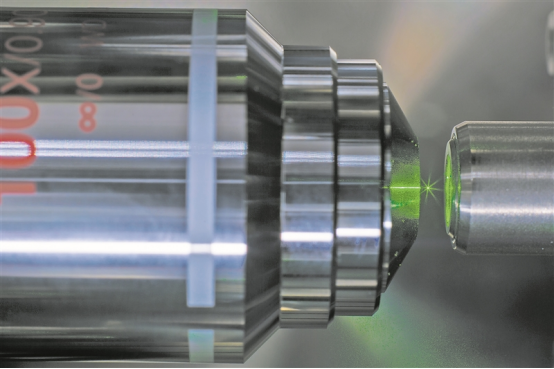
A phonon laser enables precise control of phonons. Image credit: University of Rochester, USA
A research team from the University of Rochester and the Rochester Institute of Technology has developed a novel squeezed phonon laser that achieves high-precision control of phonons at the nanoscale. According to the researchers, this technology is expected to provide new experimental tools for exploring the nature of gravity, particle acceleration and quantum physics. The related findings were published in the latest issue of Nature Communications.
Since the invention of the laser in the 1960s, the technology has continuously expanded the boundaries of scientific research and daily applications—from supermarket barcode scanning to laser vision correction surgery, none of these scenarios would be possible without lasers. Conventional lasers manipulate photons, the elementary particles of light. Today, however, scientists are extending this "laser paradigm" to another type of elementary particle: phonons, which is expected to open up new pathways for quantum metrology and precision navigation.
A phonon can be understood as the smallest unit of vibrational energy inside a material. Over the past two decades, scientists have gradually developed phonon laser technology analogous to optical lasers, allowing mechanical vibrations to be coherently controlled just like light. However, a core challenge for its application in precision measurement is reducing noise interference.
Back in 2019, the research team used optical tweezers to trap and levitate phonons in a vacuum environment, demonstrating a phonon laser for the first time. In this new study, they further applied optical regulation to exert fine "push-pull" control over the phonon laser, thereby significantly suppressing fluctuations in the system.
The team noted that while a laser appears to the naked eye as a stable beam of light, it actually contains abundant internal fluctuations. These fluctuations translate into noise during measurement, distorting signals and reducing measurement accuracy. By "squeezing" the phonon laser to cut down its thermal noise, the researchers successfully improved signal stability.
This noise-suppressed phonon laser is expected to deliver higher-precision acceleration measurement than conventional photon lasers or radio frequency technologies. Going forward, such technology could be used to develop high-precision gravitational sensors and underpin quantum navigation technologies. For instance, the scientific community is exploring satellite-signal-free quantum compasses, which could theoretically serve as a more accurate and interference-resistant alternative to GPS. The researchers believe that phonon laser technology is set to become one of the key foundations for realizing such quantum navigation systems.
 Vietnam Plant + Europe Upgrade: Laser Leader Deepens Global Push
 Three global heavyweights step up their China bets: What's behind the move?
 Big Four laser earnings: Winners, losers, and the ones fighting back
 Photonic chips land ¥1.1B in orders, funds, and financing
 Five Laser Firms See Executive Reshuffles: Younger Leaders Take the Helm
 Laserion: Breaking Ultrafast Laser Bottlenecks to Industrialize Homegrown High-End Sources
 XTRI-tech's Yao Caihong: Building High-End Manufacturing
 Glitterin Tech's Three Photonic Pillars: Building the Optical Backbone of the AI Era
 A Female Pioneer's 20-Year Quest for World-Leading Laser Thin Film Breakthroughs
 HSG Laser's He Hongming: Innovation Drives Laser Manufacturing Future