
Qiming Photonics: Nobel-Powered "Optical Engine" for the Computing Age
source:Laserfair.com
keywords:
Time:2026-04-07
Source: Laserfair.com 24th Mar 2026
Against the backdrop of explosive growth in AI computing power demand, the physical limits of traditional electrical interconnection have become the core bottleneck restricting computing power improvement, and optical interconnection has emerged as the key to breaking through the "10,000-card cluster" constraint.In this context, Qiming Photonics (Beijing) Technology Co., Ltd., originating from Peking University’s top laboratory, is striving to break the deadlock with chip-based high-performance light sources.
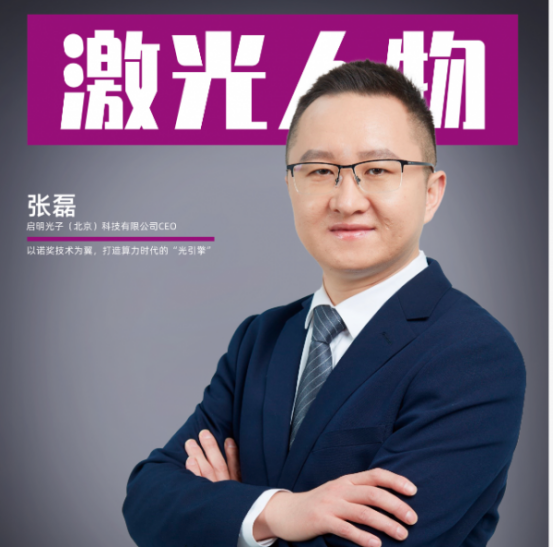
In a recent exclusive interview with Laser Manufacture News, Zhang Lei, CEO of Qiming Photonics, revealed that as a pioneer in chip-based high-performance light sources, the company’s core product — the chip-integrated optical frequency comb — has achieved a globally leading breakthrough with 34-channel parallel transmission.Supported by its 10Hz-level ultra-narrow linewidth laser technology, it provides a new "optical I/O" solution for data centers, quantum communication, automotive radar and other fields.
Founded just two years ago, this hard-tech firm is committed to applying Nobel Prize-level cutting-edge technology to reshape the underlying interconnection architecture of the computing power era, driven by the trend of "optics replacing copper", and helping China secure fundamental breakthroughs in the global optical chip competition in the post-Moore era.
Laser Manufacture News: Hello, thank you for speaking with Laser Manufacture News. We understand Qiming Photonics’ core technologies stem from cutting-edge research by the Advanced Integrated Photonic Chip Lab at Peking University. First, could you tell us what opportunity or industry insight led you and your team to found Qiming Photonics in 2024 and bring chip-integrated optical frequency comb technology from lab to market? What was the founding background? In transitioning from university research to industrialization, what key turning points did you experience? And what is the company’s core development philosophy?
Mr. Zhang: The birth of Qiming Photonics is essentially a combination of technological maturity and a market inflection point. Academically, our core technologies come from the Advanced Integrated Photonic Chip Lab at Peking University. Optical frequency combs won the 2005 Nobel Prize in Physics and act as a "light ruler" for precision measurement, yet they have long been bulky and expensive. In a 2020 study published in Nature, our team solved the "plug-and-play" problem of microresonator optical frequency combs and achieved chip-scale integration.
From an industry perspective, the computing power tsunami driven by AI large models since 2023 has made us realize that traditional electrical interconnection (copper wires) has hit physical limits. While NVlink is powerful, bottlenecks in bandwidth, power consumption and latency have grown severe for 10,000-card clusters and even million-card clusters. The industry urgently needs an "optical I/O" solution with massive parallelism and ultra-low power use.
A key turning point was realizing that labs pursue "0-to-1" performance leadership, while industrialization needs "1-to-100" stability. So in July 2024, incubated by the Peking University Shanghai Lingang Center, we officially founded Qiming Photonics. Our core philosophy is one sentence: "Turn cutting-edge, high-threshold integrated photonic chip technology into a standardized technological foundation for the computing power era."
Laser Manufacture News: As a hard‑tech startup, the team is your core competitiveness. Please brief us on Qiming Photonics’ current team structure, and in particular, how the team translates top academic achievements into practical capabilities solving industrial pain points through industry-academia-research integration.
Mr. Zhang: The success of hard-tech startups from research institutions hinges on building a deterministic path from scientific principles to engineered products. Qiming Photonics’ core competitiveness lies exactly in this unique two-wheel-drive industry‑academia‑research model.
At present, the team has over 50 members, including more than 10 PhDs. Core team members are mainly from top domestic research institutions such as Peking University and the Chinese Academy of Sciences, as well as globally leading semiconductor and optical communication enterprises.
Our industry-academia-research translation is not simple technology licensing, but deep logical division of labor. Backed by the Advanced Integrated Photonic Chip Lab at Peking University, we maintain an extreme pursuit of the fundamental mechanisms of integrated photonics. As a founder of chip‑integrated optical frequency combs, the team has published a series of milestone achievements in top journals including Nature and Science, responsible for 0-to-1 scientific breakthroughs in the lab, ensuring our source technology leads the global level by 2–3 years. The corporate team’s task is to convert high-performance research prototypes from lab conditions into commercial products that meet industrial standards, feature high yield and long‑term reliability. This involves in‑depth optimization of silicon photonic PDKs (Process Design Kits), high-speed packaging for optoelectronic chips, and stringent reliability verification. By establishing standardized production processes, we have overcome challenges in environmental adaptability and mass-production consistency of lab results, completing the leap from scientific prototypes to industrial-grade photonic chips.
Laser Manufacture News: On financing, we note that Qiming Photonics announced the completion of a tens-of-millions-yuan angel round led by CAS Star in 2025. What substantial progress has the company made in team building, R&D investment and pilot line construction since this round of funding was in place? How is your current dual-city layout — ”R&D in Beijing, pilot & mass production in Hangzhou“ — planned?
Mr. Zhang: As business demand grows, the company is continuously increasing R&D investment. In 2026, we plan to add more than 10 members to our engineering team, focusing on strengthening professional capabilities in Co-packaged Optics (CPO) module development, automated test systems and integrated light source mass production management.
Hardware infrastructure is a prerequisite for large-scale delivery. Our 2,000-square-meter pilot production base in Hangzhou has reached a critical stage:In April 2026, the factory building and cleanroom project will be fully completed, with installation, positioning and single-machine debugging of core production equipment officially launched.In June 2026, joint debugging of equipment is expected to finish, marking full line commissioning.
Beijing Headquarters: Positioned as core R&D center. Leveraging Beijing’s sci-tech innovation resources, we focus on architecture definition for chip-integrated optical frequency combs and optical I/O.
Hangzhou base: Positioned as process verification, reliability testing and large-scale mass production center. By being close to industrial clusters, we optimize supply chain collaboration efficiency and ensure rapid transition from demo samples to commercial batch production.
Laser Manufacture News: The light source is the "heart" of optical communications. Qiming Photonics positions itself as a "pioneer in chip-based high-performance light sources". What are your current flagship products? Please highlight your breakthroughs in the two core technologies: integrated external cavity narrow linewidth lasers and chip-integrated optical frequency combs. What competitive advantages do they offer in performance and cost over traditional solutions?
Mr. Zhang: For the chip-integrated optical frequency comb: Traditional solutions require 32 separate lasers to achieve 32-channel transmission, while we only need a single chip. It generates a series of equally spaced laser wavelengths, reducing the footprint by over 90%. Thanks to the inherent precision of its wavelength spacing, it eliminates the need for complex feedback control circuits, dramatically cutting system power consumption. While Ayar Labs has achieved 16 channels, we have made a breakthrough with 34 channels.
For the integrated external cavity narrow linewidth laser: Leveraging an ultra-high Q factor silicon nitride external cavity structure, we compress the linewidth down to the 10 Hz level, compared to conventional DFB lasers which typically have linewidths in the megahertz (MHz) range. This is critical for long-haul coherent communications and high-precision LiDAR.
Laser Manufacture News: We understand your products cover multiple sectors including data center optical interconnection, quantum information, and automotive LiDAR, and have supported the development of the world’s first large-scale quantum communication network. Could you share in detail the commercial deployment of your core products in various application scenarios, and what industry pain points they address in each?
Mr. Zhang:
Data Centers: This is our core battleground. We solve the Scale-up bottleneck of GPU clusters through optical I/O, achieving a global leading transmission throughput of 60 Tb/s.
Quantum Information: In February 2026, we supported the Peking University team in publishing their research on large-scale quantum communication networks in Nature. Our integrated optical frequency comb solved the challenge of light source coherence in multi-user networks, enabled parallel communication for 20 chip-based users, and verified its engineering application potential.
Automotive LiDAR: Our narrow linewidth laser provides a high-performance, low-cost light source for Frequency Modulated Continuous Wave (FMCW) LiDAR, and has passed verification from leading domestic LiDAR manufacturers.
Laser Manufacture News: The ongoing AI large model boom has triggered a computing power tsunami, making 10,000-card interconnection a critical requirement. How does Qiming Photonics’ proposed optical I/O solution address the bandwidth and power consumption bottlenecks plaguing traditional copper and optical interconnection? What is the current status of customer validation for your products in the data center and high-performance computing (HPC) sectors?
Mr. Zhang: As AI intelligent computing centers evolve from 10,000-card to million-card clusters, the core challenge lies in breaking through the physical limits of high-bandwidth domains in scale-up architectures. Current electrical interconnection solutions (such as NVlink) are constrained by signal integrity (SI), insertion loss and the power wall, with extremely limited physical reach, which imposes a hard upper limit on the scale of GPU interconnection within a single compute node.
With our underlying architecture combining chip-integrated optical frequency combs and microring modulators, Qiming Photonics has fundamentally rearchitected the energy efficiency and bandwidth density of optical I/O. We leverage the Kerr nonlinear effect to generate optical frequency combs in silicon nitride microresonators, with a single chip delivering more than 34 equally spaced coherent subcarriers. Paired with microring modulators — which are just 1% the size of traditional Mach-Zehnder modulators (MZMs) — we achieve ultra-high integration density for wavelength division multiplexing (WDM).
Laser Manufacture News: Beyond data centers, your products also have a presence in quantum information, optical fiber sensing, automotive LiDAR and other fields. In particular, your technology recently supported the Peking University team in publishing research on a large-scale quantum communication network in Nature. What technological versatility of your products does this achievement demonstrate? What is the company’s market expansion strategy for non-communication sectors going forward?
Mr. Zhang: The underlying philosophy of Qiming Photonics is to build a universal high-performance integrated photonic engine. Our core components — integrated optical frequency combs and narrow linewidth lasers — have exceptional applicability across all fields requiring precision coherent light sources.
Our expansion strategy for non-communication sectors is to remain a supplier of chips and light sources, and not compete with downstream module or system vendors. By delivering high-performance "photonic engines", we enable our partners to achieve advanced system integration.
Laser Manufacture News: Silicon photonics is widely regarded as a critical technology for the post-Moore era. As a technology pioneer in the industry, what is your view on the current development of the silicon photonics industry in China and globally? Driven by the surging demand for AI computing power, what development trends will optical interconnection technology follow in the next 3 to 5 years?
Mr. Zhang: The silicon photonics industry is currently evolving from traditional 800G/1.6T optical modules to Co-packaged Optics (CPO) and On-Chip Optical Interconnect (OIO), with international giants accelerating supply chain integration. In the next 3 to 5 years, optical interconnection will show three major trends: a shift from scale-out to scale-up architectures, the mainstream adoption of Dense Wavelength Division Multiplexing (DWDM), and continuous advances in energy efficiency. Chinese enterprises need to leverage their advantages in the domestic computing power market to achieve fundamental breakthroughs in core links such as high-performance integrated light sources, in order to compete in the global post-Moore era landscape.
Laser Manufacture News: We understand that Qiming Photonics has won the Top 10 Optical Industry Technologies in China - Future Award and the Second Prize of the Zhangjiang Cup Silicon Photonics Competition, drawing widespread industry attention. What do you believe is the company’s biggest competitive moat amid fierce market competition? Faced with potential industry reshuffling in the future, what development roadmap and strategic goals has the company set?
Mr. Zhang: Qiming Photonics’ greatest competitive moat lies in our deep mastery and rapid iteration capability for the dual-core architecture of chip-integrated optical frequency combs + microring modulators, which ensures we maintain a 2–3 year technological generation lead over the industry. Our strategic goals are clear: in 2026, we will commission the Hangzhou pilot line, achieve mass production of core components, and secure our first batch of large-scale orders in the data center and quantum information sectors; between 2027 and 2028, we will launch photonic engines with higher integration levels to fully enable the underlying interconnection upgrade of AI intelligent computing centers.
Laser Manufacture News: With the rapid development of artificial intelligence driving an explosive surge in computing power demand, short-reach optical interconnection technology has become critical. What is your view on the development trends of the laser industry, especially the optical interconnection sector? How will Qiming Photonics adapt to these trends to achieve its own sustainable development? And what is your outlook for the future of the industry?
Mr. Zhang: Driven by artificial intelligence’s relentless pursuit of computing power density, "optics replacing copper" has evolved from an industry consensus into an industrial imperative. Qiming Photonics will align with the industry trends of integration, low power consumption and high bandwidth, continue to deepen the industry-academia-research collaboration mechanism, and accelerate the translation of Nobel Prize-winning optical frequency comb technology into standardized industrial chips. We look forward to forging strong partnerships with upstream and downstream players across the industrial chain to jointly build a thriving integrated photonic chip ecosystem. Through technological innovation to drive down costs, we will lead the large-scale industrialization of optical interconnection technology amid the wave of the digital economy.
 Order Frenzy: Laser Earnings Reveal 10B+ Backlogs — Who Wins?
 AI Compute Land Grab: What 30 Laser Earnings Reports Reveal
 Action-Cam Pioneer's Optical Pivot? GoPro to Sell Itself to Optics Firm for $285M
 Wuhan Team "Grows"Next-Gen Photovoltaic Film to Let Solar Panels Harvest More Sunlight
 Vietnam Plant + Europe Upgrade: Laser Leader Deepens Global Push
 Yang Gaojie, Rationalite Photonics: 3D Optical Computing to Break AI's Compute Wall
 Kingfit's Jin Songqing: Powering the Laser Industry Chain with Advanced Cooling Technology
 Laserion: Breaking Ultrafast Laser Bottlenecks to Industrialize Homegrown High-End Sources
 XTRI-tech's Yao Caihong: Building High-End Manufacturing
 Glitterin Tech's Three Photonic Pillars: Building the Optical Backbone of the AI Era