
8 Laser Leaders Debate Laser-AI Integration & Two-Way Empowerment at Shanghai Summit
source:Laserfair.com
keywords:
Time:2026-04-07
Source: Laserfair.com 23rd Mar 2026
On March 18, 2026, "Lighting the Future: —2026 China Laser Leadership Summit & CEO Shanghai Secret Light Night", hosted by Laserfair.com and co-organized by Guangdong Laser Industry Association, Laser Application Branch of China Optics and Optoelectronics Manufacturers Association, and Shenzhen Laser Intelligent Manufacturing Industry Association, was grandly held at Kerry Hotel Pudong, Shanghai.
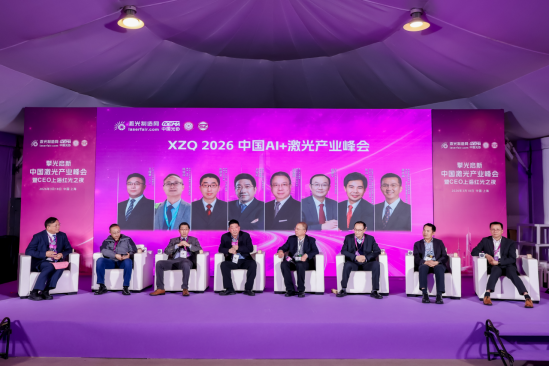
As the core session of the summit, the roundtable forum of "XZQ 2026 China AI + Laser Industry Summit" gathered eight heavyweight guests from the laser industry to conduct in-depth discussions on the theme of "Laser-Intelligence Integration Drives the Future".
Closely following the hot topic of "fostering a new form of intelligent economy" from the National Two Sessions, the forum focused on the two-way empowerment path of laser and AI, and heatedly debated core issues such as the competition between general large models and vertical small models, the dilemma of data sharing and privacy protection, and the importance of industry-university-research collaborative innovation. It presented a feast of ideas spanning cutting-edge academia to industrial practice, injecting new momentum into the high-quality development of China's laser industry.
The roundtable forum was moderated by Professor Wang Chengyong, former Vice President of Guangdong University of Technology. Top experts from academia and industry gathered on stage to share insights, including Qiu Jianrong, Director of the Institute of Micro-Nano Photonics at Zhejiang University; Yao Jianhua, Dean of the School of Mechanical Engineering at Zhejiang University of Technology; Professor Chen Jimin from the School of Physics and Optoelectronic Engineering of Beijing University of Technology; Chen Yan, Vice President of Han's Laser and Chairman of Shenzhen Han's Vision Technology Co., Ltd.; Deng Jiake, General Manager of Wuhan HG Laser Engineering Co., Ltd.; Zhou Jianbo, General Manager of IPG Photonics (Beijing) Co., Ltd.; and Nie Shuibin, Co-founder and Group Vice President of Hymson Laser Technology Group Co., Ltd.
1. Model Debate:
Large Models vs. Small Models – Which Path Is More Viable?
At the forum, participating guests engaged in a profound clash of views on the critical issue of whether large models or small models should serve as the core carrier of "Laser + AI".
Professor Chen Jimin pointed out that while current general large models boast massive parameters, they underperform in specialized fields such as laser processing. He called on the industry to concentrate computing resources to train dedicated large models for laser processing, arguing that this is the ultimate solution to address common industry challenges and can serve all practitioners just as general large models serve daily life.
Dean Yao Jianhua also proposed a "two-tier architecture" vision: national-level support is needed to build an open and shared "general laser large model" as the infrastructure, while enterprises should develop private "specialized small models" to form their core competitiveness.
However, entrepreneurs from the frontline of the industry expressed more cautious views.
Chen Yan noted that due to the huge disparities in hardware parameters and optical systems across different manufacturers' equipment, it is "virtually impossible" to cover all scenarios with a single general large model. He emphasized that the high degree of personalization in industrial scenarios dictates that small models are the way to go, and forced standardization would instead erase enterprises' core competitiveness.
Deng Jiake adopted a pragmatic middle-ground strategy, proposing a "from small to large" path: first build high-precision small models for specific scenarios such as welding and cutting, then aggregate them into an industry-wide large model through industry sharing mechanisms.
2. Data Dilemma:
How to Achieve Dialectical Unity Between Sharing Ecosystem and Privacy Moat?
Data is the fuel of AI, yet how to balance the "public" and "private" attributes of data became another intense and thought-provoking discussion at the summit. While calling for breaking down data silos, the guests were also deeply aware of the necessity of data asset protection.
Among them, several entrepreneurs unanimously emphasized the urgency of data governance.
Deng Jiake revealed that HG Laser has been committed to digitizing process parameters since 2018, enabling equipment to issue self-alerts in sub-health status through "intelligent health checks". Zhou Jianbo stated that AI can convert the experience of senior engineers into data assets, solving the problem of technology loss caused by talent turnover, which highlights the public value of data accumulation for industry inheritance.
Nie Shuibin shared Hymson's explorations in AI applications, including using AI to optimize cutting head algorithm stability, implementing intelligent order scheduling to replace manual clerks, and remotely predicting equipment failures via sensors and automatically dispatching maintenance orders. He emphasized that AI will replace a large number of repetitive tasks, but the industry needs to jointly address the challenges of data integration.
Wang Chengyong pointed out that lasers are evolving from mere tools into "a combination of brain and eyes", and called on the industry to break down barriers to multimodal data governance and jointly shape a new form of intelligent economy for China's laser industry through industry-university-research collaboration.
Dean Yao Jianhua suggested that against the backdrop of the 15th Five-Year Plan, the state should promote the establishment of basic "data clouds" and public databases to support the research and development of general models, while enterprises' core process data should be strictly protected as trade secrets.
3. Two-Way Empowerment:
Logical Restructuring of Laser Laying the Foundation for AI and AI Reshaping Manufacturing
Regarding the relationship between laser and AI, the guests moved beyond the one-way thinking of "AI empowering laser" and delved into the profound logic of their mutually foundational and bidirectionally transformative nature.
Professor Qiu Jianrong further corroborated this from the perspective of materials science, noting that breakthroughs in femtosecond laser for micro-nano processing and photonic chip manufacturing directly determine the performance ceiling of AI hardware such as optical computing chips. He emphasized that laser is not merely a tool, but the "mother machine" for the iteration of AI hardware.
Dean Yao Jianhua put forward a forward-looking view of "laser feeding back to AI". Taking laser drilling as an example, he pointed out that only laser processing can ensure the consistency between the first hole and the 1000th hole, and this extreme stability is the physical foundation for the operation of intelligent systems. "Without the precise support of laser technology, no matter how advanced AI algorithms are, they cannot be implemented."
On the other hand, AI's reshaping of manufacturing logic is equally profound. Zhou Jianbo shared the application of AI in complex welding scenarios: using visual recognition to reject defective products and OCT to monitor weld quality in real time, turning the traditional "black box" process that relied on manual experience into a transparent and controllable data flow.
Chen Yan depicted the paradigm shift brought by "machine vision + AI": evolving from simply "being able to see" to "being able to understand and self-learn", enabling equipment to perceive the environment and make autonomous decisions.
In this regard, the participating guests also reached a certain consensus: the future will no longer be a simple superposition of "laser + AI". Instead, laser will provide execution capability at the physical limit, while AI will provide intelligence for cognitive decision-making, and the two will jointly restructure the value chain of the manufacturing industry.
4. The Question of Originality:
The End of Trial-and-Error and the New Mission of Industry-University-Research Collaboration
On how to achieve the leap from "following" to "leading", guests from academia and industry reached a high degree of consensus on the path to original breakthroughs, while also putting forward new requirements for the talent training model.
While pointing out bluntly the current "pain points" of the industry, Professor Qiu Jianrong reflected on the inefficiency of the traditional trial-and-error R&D model. He advocated using AI for Science to accelerate new material design and process optimization, but emphasized that AI cannot replace original innovation in basic science, and universities must return to "conducting genuine original exploration".
Dean Yao Jianhua pointed out that the core of the 15th Five-Year Plan is to shift from single-technology leadership to full industrial chain leadership. This requires universities to leverage their advantages in free exploration and tackle cutting-edge challenges such as the processing of lightweight materials for the low-altitude economy.
Regarding the talent shortage, the guests proposed innovative collaborative solutions. Yao Jianhua suggested integrating entrepreneurs' practical experience into university curricula through an "Expert Lecture Series", allowing master's and doctoral students to align with industrial needs while still in school. Chen Jimin, for his part, called on entrepreneurs to increase investment in basic research and support universities in carrying out long-cycle original research projects.
5. Future Vision:
Restructuring the Entire Value Chain, Laser + AI Embarks on a Smart Manufacturing Future
In the final "2030 Vision" session of the roundtable dialogue, despite the diverse expressions of the guests, their core aspirations were highly consistent: to enhance the core competitiveness and international discourse power of China's laser industry through the in-depth integration of laser and AI.
Throughout the entire dialogue, the participating guests delved into discussions ranging from the top-level design of national strategies to the "frontline battle" of data governance; from the evolution of intelligent single-unit equipment to the restructuring of the entire industrial ecosystem... They not only focused on solving current pain points but also envisioned the global blueprint during the 15th Five-Year Plan period.
In his concluding remarks, Professor Wang Chengyong emphasized that the integration of laser and AI is not a simple superposition of technologies, but a profound restructuring of the entire value chain covering R&D, production, services and business models. He called on the industry to work hand in hand to jointly promote the intelligentization process of the laser industry, so that China's laser can not only illuminate the world, but also "intelligently manufacture" the future.
 Order Frenzy: Laser Earnings Reveal 10B+ Backlogs — Who Wins?
 AI Compute Land Grab: What 30 Laser Earnings Reports Reveal
 Action-Cam Pioneer's Optical Pivot? GoPro to Sell Itself to Optics Firm for $285M
 Wuhan Team "Grows"Next-Gen Photovoltaic Film to Let Solar Panels Harvest More Sunlight
 Vietnam Plant + Europe Upgrade: Laser Leader Deepens Global Push
 Yang Gaojie, Rationalite Photonics: 3D Optical Computing to Break AI's Compute Wall
 Kingfit's Jin Songqing: Powering the Laser Industry Chain with Advanced Cooling Technology
 Laserion: Breaking Ultrafast Laser Bottlenecks to Industrialize Homegrown High-End Sources
 XTRI-tech's Yao Caihong: Building High-End Manufacturing
 Glitterin Tech's Three Photonic Pillars: Building the Optical Backbone of the AI Era