
Scientists Overcome Key Stability Hurdle, Bringing Compact Low-Cost Free-Electron Lasers Closer
source:cnBeta.COM
keywords:
Time:2026-10-27
Source: cnBeta.COM 8th Oct 2026
Researchers from the Helmholtz-Zentrum Dresden-Rossendorf (HZDR) in Germany and the SOLEIL synchrotron facility near Paris, France, have announced a major breakthrough in the development of a new generation of compact free-electron lasers. For the first time, the team achieved stable, repeatable operation of a laser-plasma free-electron laser in a high-gain regime, paving the way for future free-electron laser facilities that are smaller and less expensive.
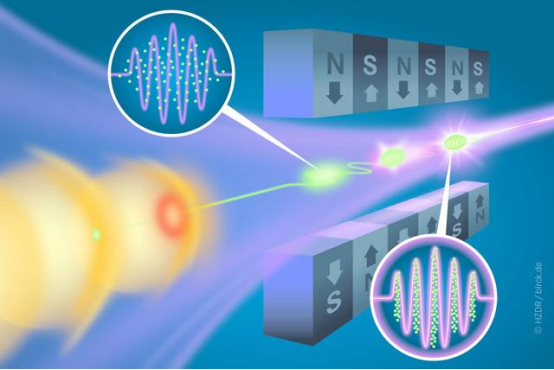
Free-electron lasers are important tools in modern scientific research, capable of producing extremely short and intense pulses of light that are widely used to study atoms, molecules, and novel materials. However, most free-electron laser facilities worldwide are large and costly, and available experimental time is limited, so researchers have long sought more compact and affordable alternatives.
Conventional free-electron lasers require large accelerators, sometimes up to two kilometers long, to accelerate electrons to near the speed of light. The electron beam then enters an undulator made of magnets, where it oscillates and emits highly coherent, intense light pulses.
The new laser-plasma free-electron laser takes an entirely different approach. Researchers use lasers to generate special waves in a plasma, allowing electrons to "surf" on the plasma wave and accelerate rapidly. With this mechanism, energy levels that previously required hundreds of meters or even kilometers of acceleration distance can now be reached in just a few millimeters, shortening the overall acceleration distance by roughly a factor of 1,000.
Despite these clear advantages, the technology has long suffered from insufficient stability. For scientific experiments, laser output must maintain consistent quality for hours or even days, a standard that laser-plasma free-electron lasers had previously struggled to meet.
The key to this breakthrough was the team's success in precisely controlling the laser-plasma interaction. Using HZDR's high-performance DRACO laser system, scientists fired infrared laser pulses into a gas jet only a few millimeters thick, creating a stable plasma environment and precisely tuning the laser parameters to optimally match the plasma conditions.
After acceleration, the electron beam was directed into the undulator system. The researchers further introduced an interaction mechanism between the laser pulses and the electron beam to enhance the free-electron laser radiation intensity and achieve higher energy output.
Experimental results showed that the team successfully produced high-energy ultraviolet light pulses at a wavelength of 272 nanometers. More importantly, the laser power exhibited, for the first time, the exponential growth characteristic of a high-gain regime, demonstrating that the system had entered a strongly amplified operating mode. This state is regarded as an important marker of high-performance free-electron laser operation.
The researchers said the experiment represents a significant advance over results the team published in 2023. Laser-plasma free-electron lasers, which previously could not be reliably repeated, can now stably and continuously produce high-quality radiation, opening the door to practical scientific applications.
The scientific community broadly considers this achievement capable of driving free-electron laser technology toward miniaturization and wider adoption. Future facilities may no longer need to be built at large national laboratories but could shrink to a scale affordable for universities and mid-sized research institutions, giving more research teams access to advanced light sources.
The researchers noted that the system currently produces light in the ultraviolet range, but with further upgrades and optimization, the wavelength could potentially be shortened to below 100 nanometers. At that point, such compact free-electron lasers would show even greater value in materials science, the observation of chemical reactions, biomedical research, and nanotechnology.
The results were published in the journal Physical Review Letters and are seen as an important milestone on the path toward miniaturizing free-electron lasers, as well as a practical foundation for building more economical and easily deployable advanced light source facilities in the future.
 XZQ 2026 Laser Cleaning Summit Debuts at CIIF, Explores Scalable Applications
 Bambu Lab Enters Lasers, Extending from 3D Printing to Desktop Manufacturing
 Hesai Inks Two Strategic Partnerships, Unveils MT-Series Lidar
 RMB 6B+ Investment Adds New Player to Jiangsu's Laser Industry Landscape
 Order Frenzy: Laser Earnings Reveal 10B+ Backlogs — Who Wins?
 Kuntai Laser: Full-Stack Solutions for Laser Intelligent Equipment and Manufacturing Upgrades
 Thunder Laser's Chen Biqin: Two Decades of Laser Self-Reliance
 Yang Gaojie, Rationalite Photonics: 3D Optical Computing to Break AI's Compute Wall
 Kingfit's Jin Songqing: Powering the Laser Industry Chain with Advanced Cooling Technology
 Laserion: Breaking Ultrafast Laser Bottlenecks to Industrialize Homegrown High-End Sources