
Thunder Laser's Chen Biqin: Two Decades of Laser Self-Reliance
source:Guangdong Mechanical & Electri
keywords:
Time:2026-10-26
Source: Guangdong Mechanical & Electrical Polytechnic 9th Oct 2026
In the showroom of Dongguan Thunder Laser Equipment Co., Ltd., rows of laser cutting machines stand neatly arranged, their beams moving precisely across materials to cut hair-thin patterns. Chairman Chen Biqin stands in front of one machine, watching the beam rise and fall with a calm, steady confidence.

In 2007, he graduated from Guangdong Mechanical & Electrical Polytechnic with a degree in Mobile Communication Technology and entered the communications industry. Today, Thunder Laser has grown from a startup with three employees to a high-tech enterprise with more than 200 staff, with a sales network covering over 50 countries and regions. It has become one of the pioneers in global laser STEAM education.
Spanning both communications and laser manufacturing, Chen Biqin has carved out a path of “chasing light.”
Early Inspiration: A Boy Who Took Machines Apart Plants the Seeds of Engineering
Chen Biqin was born into an ordinary family in Lufeng, Shanwei, Guangdong. There was no business tradition in the family, but he was given plenty of room to grow.
“I was fascinated by science and physics from an early age,” Chen recalls. As a child, his greatest pleasure was tinkering with radios—taking them apart and putting them back together, determined to figure out how sound actually came out of those tiny components. In 1999, the family got its first computer, a second-hand machine they had picked up. “Second-hand computers have one thing in common: they’re unstable and break easily.” When something broke, it had to be fixed. After enough repairs, he naturally learned the computer’s “temperament.”
That experience gave him a strong interest in communications technology—especially fiber-optic and laser communications—while he was still in high school. “Mobile phones were becoming widespread at the time, and I felt this was where the future was heading.” When it came time to fill in his college preferences, he learned that Guangdong Mechanical & Electrical Polytechnic had just launched a mobile communications major. His reasoning: newly established majors tend to have more practical curricula and are closer to what companies actually need. “I wanted to study that.”
Education: Two Years at Guangdong Mechanical & Electrical Polytechnic Build a Pragmatic Foundation
In 2005, Chen Biqin entered Guangdong Mechanical & Electrical Polytechnic. The campus environment was far less polished than it is today, and his class was split across two dormitory areas.
With the dormitories separated, how to hold the class together became the first issue he had to tackle after becoming class monitor. “We consciously communicated with the school and found ways to connect students from the two dormitory areas.” Even then, he showed organizational and coordination skills beyond his years.
During his two years at the polytechnic, Chen says he received “all-round development.” Academically, his grades were consistently good, and he won every scholarship he was eligible for. In student work, he served as deputy head of the department’s organization department and as class monitor. “Being class monitor trained my ability to learn and communicate.” He remembers clearly that many classmates came from families facing financial difficulties, so organizing activities required special attention to everyone’s feelings. “We encouraged students from better-off families and students from less well-off families to take part in work-study together, and then used the money we earned together to fund activities. Everyone was paid for equal work, and no one was left on the outside.” That fair and pragmatic class atmosphere created a strong sense of cohesion, something Chen still remembers vividly.
What he also remembers fondly is Mr. Zha Hongshan’s microcontroller course. “We were learning assembly language, which places high demands on logical thinking.” Although microcontroller programming has long since switched to C, that experience of “digging down into the underlying logic” gave him a solid technical foundation. The teachers at the polytechnic often said: “First get your foot in the door and get hands-on; after that, you can keep exploring, reflecting, and improving.” Chen has remembered that sentence for more than a decade. “Teachers give you a possibility, but to truly master a technology, you have to learn by doing and do by learning. Later, when I started my own business and even when I crossed into lasers, I understood one thing clearly: others can open the door for you, but you have to dig in yourself to truly master the core technology.”
Outside of class, he also helped classmates assemble computers. “Fix enough of them, and you understand them. Helping a classmate build a computer meant spending money on transportation, food, and water, there were costs. But if you create value for others, they will give something back. I learned the simplest truth from that: when you create value, you can earn a return.” That small entrepreneurial experience gave him his first taste of “trading labor for reward,” and it also left him with a belief he has held firmly since founding Thunder Laser: first ask what value you can create for society, and only then talk about profit.
Starting from Scratch: Creating Value, Earning Profit
After graduating in 2007, Chen Biqin joined a communications company in Guangzhou. He started as a technical engineer and later moved into project management. “Engineering work is never smooth sailing. Problems keep coming up, and you keep solving them.” That experience taught him how to coordinate resources under constraints, and gave him a quiet confidence that every difficulty can be overcome.
Between 2007 and 2011, he first encountered laser equipment at a trade show. A hair-thin beam could process all kinds of materials without contact, in a digital and customizable way, and he saw a huge business opportunity. “Lasers can connect to all kinds of materials in the physical world. With so many materials and shapes, the possibilities for civilian applications are enormous.”
What strengthened his conviction even more was the story of domestic substitution in the communications industry.
“In the 2G era, overseas communications giants dominated the market. In the 3G era, Huawei, Datang, and ZTE rose with better technology and more reasonable prices, and Chinese communications vendors officially joined the world’s top tier.” He believed the laser industry would follow the same path. “As long as China achieves technological breakthroughs, the same domestic substitution can happen, and Chinese companies can go global.”

The office in the early days of the startup
In 2011, Chen Biqin and two partners pooled together tens of thousands of yuan and set out to start a business. The handful of them squeezed into a rented office, with sketches covering the whiteboard and instant noodle boxes piled up like a small hill. The startup capital was scraped together from here and there, but their confidence came from within.
In 2013, Dongguan Thunder(Lei Yu) Laser Equipment Co., Ltd. was officially established. “Thunder” comes from the English word “laser,” representing speed and power. “Yu” stands for the universe, representing ambition and breadth of vision.
Difficulties came one after another in the early days. In 2014, while developing the second-generation equipment, the microcontroller for the human-machine interface simply would not work. Chen Biqin went back to his alma mater and found a senior fellow student. “He said the logic was actually quite simple. It was just that people in the laser industry rarely used it.” That one sentence woke him up. “When tackling a difficult problem, you have to be good at integrating resources across fields. A technology that is backward in one industry may already be mature in another. Bring it in, and the problem is solved.” From then on, Thunder Laser gained another part of its DNA: constantly trying cross-industry approaches and constantly looking for new growth opportunities.
Breaking Through: Going Global and Winning Markets with Speed
In 2014, Thunder Laser’s second-generation equipment, developed jointly with a German partner, successfully entered the German market. That was the company’s first step toward internationalization. Recognition from the German market gave the team enormous confidence. They began to analyze where the biggest market was. “If the equipment is well received in Germany, the U.S. market should be fine too.” In 2017, Thunder Laser set up a distribution network and a subsidiary in the United States. “We don’t just sell equipment to customers. We deliver it to their doorstep.” That approach quickly helped Thunder Laser gain traction in the U.S. market.
In 2020, international logistics and market volatility disrupted equipment turnover in the U.S. for many companies. Thunder Laser, however, had already completed its sales network and instead found new opportunities. “Behind every layout there is only one logic: what value are you creating for customers? When I can do something at a lower cost than the customer can do it themselves, I should be the one doing it. When the value I create far exceeds the cost I incur, I am creating something different for society.”

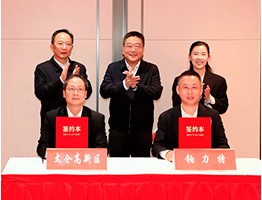
Signing ceremony at Laser World of Photonics Munich
From three employees to more than 200, from obscurity to one of the pioneers in global laser STEAM education, Chen Biqin believes the key is not any single milestone but the solidity of every step. “From three people to 30, we were solving the problem of survival. From 30 to more than 200, we began to shoulder social responsibility and contribute our part to a certain segment of China’s manufacturing industry.”
On the technology-driven front, Thunder Laser was an early mover in launching an education edition of its laser cutting software. It also worked with frontline teachers to develop a laser-making course series and built a laser-making community. “For hardware to deliver a better experience, it must be closely tied to human-machine interaction,” Chen explained. “Using software to achieve digitalization and connecting with AI technology is an ecosystem that runs from hardware to software, and it is also the thread for embracing the development of the times.”
Giving Back: Industry-Education Integration Opens a Path for Those Who Follow
In 2017, with his business beginning to take shape, Chen Biqin returned to his alma mater. He signed an agreement to donate Thunder Laser maker equipment, provided funding to support innovation and entrepreneurship training for university students, and was appointed a visiting professor. The young faces in the audience reminded him of his younger self. “The school’s solid academic atmosphere gave me good training, and the school-enterprise cooperation model helped me adapt quickly to society and work. I am willing to share new technologies and new industry directions with the school and promote school-enterprise collaboration.”
The “Light and Shadow Craftsman Talent Training Program” he promoted, built around an order-based new apprenticeship system, has trained more than 100 students and helped them secure high-quality jobs in the high-tech equipment industry across the Pearl River Delta.
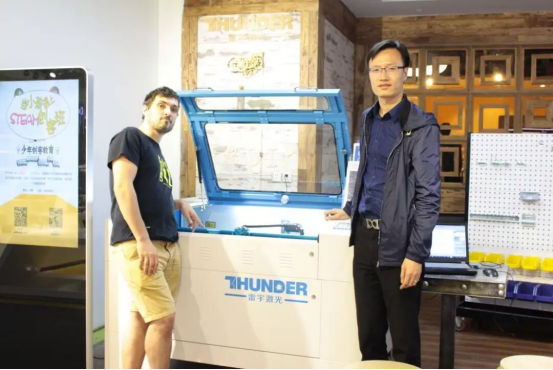
Chen Biqin takes part in a maker event
Thunder Laser has also established industry-academia-research partnerships with a number of universities at home and abroad. In 2020, the company was recognized in the first batch of industry-education integration enterprises under construction and cultivation in Guangdong Province, and it participated as a vice-chairman unit in establishing the Guangdong Electromechanical Vocational Education Group.
“Industry-education integration is the most effective model for vocational talent development,” Chen said. “For vocational college students, can this technology become the direction of your career plan? Can you understand early on what the processing needs are within this technology? That is the most exciting part of industry-education integration.”
Message: Learn by Doing, Do by Learning
From a mobile communications major to laser equipment manufacturing, from a technical role to entrepreneurship, and from domestic to international markets, Chen Biqin has a deep understanding of vocational education. “During my time at Guangdong Mechanical & Electrical Polytechnic, my biggest takeaway was learning to ‘get a foot in the door first, then go deep.’ Vocational education is only a starting point. It pushes us to keep learning and keep challenging ourselves. Maker education and innovation training taught me that you can learn by doing and keep breaking through in your skills.”
To current students, he offers this message: “Never stop learning. Keep polishing your skills and raise your professional competence and work ethic. Whether or not that particular technology proves useful later, what you are really honing is your ability to learn. That ability will let you learn different things faster once you enter society.”

Thunder Laser new product launch event
From a small city in eastern Guangdong to the international stage, from communications technology to laser manufacturing, Chen Biqin’s journey is a vivid embodiment of the school motto: “Cultivate Virtue, Strengthen Competence, Value Practice, Pursue Innovation.” That hair-thin laser beam not only cuts precision products; it also lights the path of an alumnus who keeps his feet on the ground and keeps breaking through.
 XZQ 2026 Laser Cleaning Summit Debuts at CIIF, Explores Scalable Applications
 Bambu Lab Enters Lasers, Extending from 3D Printing to Desktop Manufacturing
 Hesai Inks Two Strategic Partnerships, Unveils MT-Series Lidar
 RMB 6B+ Investment Adds New Player to Jiangsu's Laser Industry Landscape
 Order Frenzy: Laser Earnings Reveal 10B+ Backlogs — Who Wins?
 Kuntai Laser: Full-Stack Solutions for Laser Intelligent Equipment and Manufacturing Upgrades
 Thunder Laser's Chen Biqin: Two Decades of Laser Self-Reliance
 Yang Gaojie, Rationalite Photonics: 3D Optical Computing to Break AI's Compute Wall
 Kingfit's Jin Songqing: Powering the Laser Industry Chain with Advanced Cooling Technology
 Laserion: Breaking Ultrafast Laser Bottlenecks to Industrialize Homegrown High-End Sources