
Bambu Lab Enters Lasers, Extending from 3D Printing to Desktop Manufacturing
source:beiduolab.com
keywords:
Time:2026-10-26
Source: beiduolab.com 10th Oct 2026
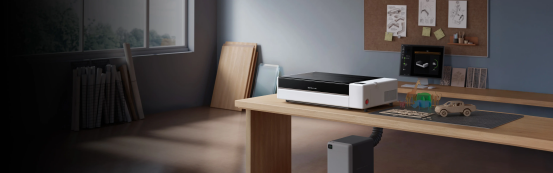
Bambu Lab, a leading Chinese 3D printing company, has launched its first laser cutter, the R1, in a bid to use engineering-driven design to lower the long-standing professional barrier around consumer-grade laser equipment.
More noteworthy than the specs is where the R1 sits within Bambu Lab’s product matrix. It marks the company’s first substantive move from a single 3D printing category into “desktop integrated manufacturing,” and signals that the consumer laser cutting segment is about to gain a new player with both engineering capability and an established user base.
Why is Bambu Lab confident enough to enter a mature market dominated by a single strong incumbent, and how is its approach different? Its product logic and market moves may offer a window into the company’s underlying capabilities and strategic intent.
I. Crossing Boundaries: Engineering Capability Lowers the Professional Barrier
Driven by three forces in recent years—manufacturing upgrades, the boom in cultural and creative industries, and growing consumer DIY demand—consumer-grade laser processing equipment has continued to gain volume. According to Tianyancha and other data sources, China’s laser cutting and engraving machine market reached RMB 5.488 billion in 2025, with a compound annual growth rate of about 6.5%, above the global average.
The other side of this market expansion is the gap between hardware and operating capability. “Optical path calibration” has long been a hidden barrier between ordinary users and professional processing. Maintaining the optical path of traditional CO₂ laser equipment relies on manual, mirror-by-mirror adjustment. Even an experienced user needs more than ten minutes to complete it, while beginners are often deterred altogether.
Bambu Lab’s R1 laser cutter is designed to break through this pain point. The R1 features a 55W CO₂laser and is equipped with optical path calibration sensors that can identify the laser path with one click and automatically correct deviations, completing calibration in as little as one minute. This significantly lowers the operating threshold of traditional CO₂ laser equipment.
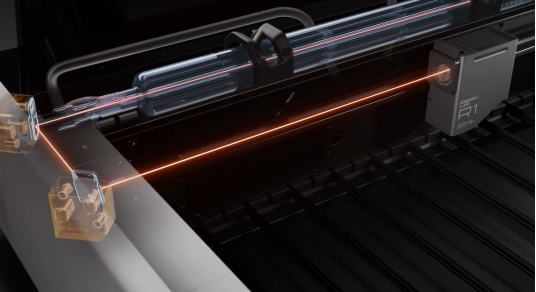
The R1 also targets professional-level requirements in precision and processing capability. It is equipped with a triple positioning system that coordinates dual cameras, dual lidars, and dual encoders in real time, achieving 0.2mm positioning accuracy. It can handle engraving and cutting across a variety of materials and complex scenarios, and can cut through 18mm black walnut plywood and 20mm acrylic at maximum thickness.

More importantly, Bambu Lab has applied motion control algorithms from its 3D printers to the R1, bringing active vibration compensation and dynamic laser output compensation into CO₂ laser processing. This effectively reduces the impact of vibration during high-speed movement of the laser head, achieving a maximum engraving speed of 1,000mm/s and acceleration of 20,000mm/s².

In terms of pricing, the R1 is launched in China at RMB 14,999 and overseas at USD 2,499. Given its 55W CO₂ laser specifications, automatic calibration, and other differentiated features, Bambu Lab is positioning the R1 as a “professional-grade entry-level device,” using a consumer-grade experience of professional capabilities to support a product premium.
Looking at the track the R1 is entering, the consumer laser cutting market has become increasingly competitive in recent years and has formed a “one dominant player, multiple strong challengers” structure. Data from CIC Consulting shows that xTool leads with about a 47% market share, more than the combined share of the second- through tenth-ranked brands. Brands such as LaserPecker and Ortur are also active in the market.
Facing a category market crowded with strong players, Bambu Lab has not chosen to enter through a price war. Instead, it is migrating motion control algorithms, visual positioning technology, and automated calibration capabilities accumulated in 3D printing into the laser category, replacing a parameter race with capability reuse and pursuing a differentiated path from existing players.
II. Ecosystem Synergy: Cross-Category Expansion Through Technology Reuse
For Bambu Lab, the R1 is only the starting point for entering the laser track. To understand why the company is making its move now, and what this step means within its broader strategy, it helps to look back at the company’s own development logic.
Bambu Lab’s rise reflects the hallmarks of “Intelligent Manufacturing Made in China.” Founder Tao Ye is an engineer who left DJI to start his own business and has a deep understanding of the underlying product logic of integrating hardware, software, and algorithms. Most of the core team also has technical roots in artificial intelligence and robotics.
In April 2022, Bambu Lab launched its first product, the X1, bringing industrial-grade printer technologies such as multi-color printing and support for high-performance engineering plastics into consumer products. With an out-of-the-box experience, it significantly lowered the barrier to using 3D printing and laid the foundation for the company’s approach of using engineering capability to reduce professional barriers.
Since then, Bambu Lab has continued to iterate higher-quality, easier-to-use desktop 3D printers, steadily expanding its product matrix. As of June 17, 2026, cumulative domestic sales of Bambu Lab’s consumer-grade 3D printers had surpassed 1 million units, only about four years after its first product hit the market.
The laser cutting track is a natural choice for Bambu Lab as it looks for incremental markets beyond 3D printing. Laser cutting and 3D printing are naturally complementary in desktop manufacturing scenarios. The former handles additive manufacturing, while the latter can cut, engrave, and surface-etch materials such as wood, leather, and metal to meet differentiated creative needs.
Bambu Lab’s confidence in entering this track comes from “technology reuse.” It does not need to build a technology stack from scratch, allowing it to enter a new category at lower cost and greater speed. The birth of the R1 marks the upgrade of its laser function from a “printer add-on module” to an “independent product line,” a key step in Bambu Lab’s move toward “desktop integrated manufacturing.”
Even more noteworthy are Bambu Lab’s profitability and organizational vitality. According to ConTEXT data, at a time when startup tech companies generally burn cash to scale, the company’s net profit was already close to RMB 2 billion in 2024, while revenue grew from about RMB 2.7 billion in 2023 to RMB 5.5–6 billion.
In 2025, Bambu Lab reached the RMB 10 billion revenue milestone, becoming the world’s first 3D printing company to cross that threshold, with a 29% share of the global consumer-grade 3D printer market. In the 2025 Hurun China 500 list released in February, Bambu Lab was nominated with a valuation of about RMB 40 billion, making it the only 3D printing company on the list.
Most importantly, the content ecosystem community built by Bambu Lab has become an important support for its hardware sales. Its original model community MakerWorld has grown into the world’s most monthly active 3D printing model community, with more than 1 million models and still expanding at a rate of 100,000 new models per month.
The R1 can plug directly into Bambu Lab’s existing ecosystem, sharing the MakerWorld model community and Bambu accounts with its printers, and using the BambuSuite workflow with support for Windows and macOS. Existing users barely need to learn a new system to achieve a natural division of labor between laser cutting and 3D printing, so the new category does not need to go through another long user education cycle.
From 3D printing to laser processing, Bambu Lab’s path has been consistent: use brand trust and user stickiness as leverage, bring the barrier of professional equipment down to a level consumer users can bear, and let ecosystem capabilities accumulate and pay off repeatedly with each category expansion.
What Bambu Lab brings to the laser track, therefore, is not just an R1, but a proven capability foundation and ecosystem. This explains why it dares to cross categories, and it also signals that competition in the consumer laser processing market will shift from single-product specifications to a broader contest of ecosystems and experience.
 Hesai Inks Two Strategic Partnerships, Unveils MT-Series Lidar
 RMB 6B+ Investment Adds New Player to Jiangsu's Laser Industry Landscape
 Order Frenzy: Laser Earnings Reveal 10B+ Backlogs — Who Wins?
 AI Compute Land Grab: What 30 Laser Earnings Reports Reveal
 Kuntai Laser: Full-Stack Solutions for Laser Intelligent Equipment and Manufacturing Upgrades
 Thunder Laser's Chen Biqin: Two Decades of Laser Self-Reliance
 Yang Gaojie, Rationalite Photonics: 3D Optical Computing to Break AI's Compute Wall
 Kingfit's Jin Songqing: Powering the Laser Industry Chain with Advanced Cooling Technology
 Laserion: Breaking Ultrafast Laser Bottlenecks to Industrialize Homegrown High-End Sources