
Cracking Nuclear Decontamination: Laser Cleaning Boosts Safe O&M and Decommissioning
source:Hydro Laser
keywords:
Time:2026-09-21
Source: Hydro Laser 5th Sep 2026
Amid the steady growth of the global nuclear power industry, the operation and maintenance of nuclear facilities and decommissioning decontamination have become core industry challenges. Data shows there are more than 490 nuclear reactors in operation or under construction worldwide. based on a 40-year service life, nearly 500 reactors will need to be safely dismantled by 2064. During nuclear plant operation, each unit generates an average of about 120,000 barrels (24,000 cubic meters) of solid waste per year. Given the disposal challenges arising during operation, decontamination technologies for the safe handling of radioactive materials are particularly important. Traditional sandblasting and chemical decontamination processes are not only inefficient but also generate large amounts of secondary radioactive waste, significantly raising disposal costs and safety risks. Against this backdrop, laser cleaning and decontamination technology has emerged as a disruptive solution in the nuclear sector, thanks to its core advantages of safety, efficiency, and low material loss.
As early as 1996, the U.S. Department of Energy (DOE) incorporated laser applications in the nuclear sector into its national strategy, identifying "laser decontamination of contaminated metals" and "laser recovery of nuclear materials" as high-priority frontier solutions—ample evidence of the technology's industry value. After decades of technological iteration, laser decontamination has now overcome the bottlenecks of traditional processes, achieving multi-scenario, high-precision, automated operation and meeting the full range of contamination treatment needs in nuclear power.
For the most common problem of contaminated metal equipment in nuclear power, the industry has developed a mature laser decontamination process. Radioactive contaminants on stainless steel and mild steel equipment in nuclear reactors can penetrate up to 4 millimeters into the substrate, making them difficult to remove completely with traditional processes. The industry has optimized a nanosecond near-infrared pulsed laser process that, by precisely controlling energy density, efficiently strips the radioactive oxide layer from metal surfaces while thoroughly removing oxide films without nuclide adsorption, eliminating radioactive residue at the source. To overcome the efficiency limitations of traditional vertical irradiation, an innovative oblique linear beam irradiation technique has been adopted, combined with a post-laser oxidation film-forming process. This not only ensures thorough decontamination but also restores the equipment's anti-corrosion performance. The core solution has been granted a patent.
Faced with the challenge of contaminated concrete structures in nuclear plants, laser technology also demonstrates unique advantages. The porous nature of concrete causes radionuclides to linger deep within, while 90% of contaminants are concentrated in the top few millimeters. Using the dual effects of laser thermal stress and dehydration expansion, the contaminated surface layer can be made to flake off naturally. Combined with composite processes such as high-power laser melt-solidification plus ultrasonic vibration and high-pressure gas powder recovery, contaminants can be precisely removed. In addition, a cylindrical vacuum recovery device with a flexible brush head can adapt to uneven wall surfaces, thoroughly solving the problem of dust dispersion during concrete decontamination.
Through continuous innovation in optical systems and supporting structures, laser decontamination has thoroughly overcome the shortcomings of traditional technologies. Early single-point CO₂ laser cleaning was relatively inefficient, but today's fiber delivery plus cylindrical linear focusing solutions have greatly improved operating efficiency. For confined, narrow spaces such as pipes and pressure vessels, technologies including laser pre-amplification, underwater dual-nozzle coordination, and lateral plus coaxial dual-airflow anti-redeposition have overcome the pain points of difficult beam delivery and contaminant re-adhesion. In addition, technologies such as ultraviolet pulsed laser shock stripping, inert gas atmosphere coating carbonization decomposition, and high-temperature laser pyrolysis of organic pollutants have enabled decontamination across all materials, including metals, concrete, resin coatings, and organic pollutants.
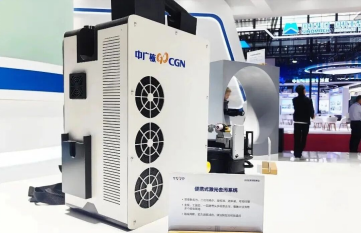
CGN Suzhou Nuclear Power Research Institute | Engineering Application of Laser Decontamination at Daya Bay, Yangjiang, and Fangchenggang Nuclear Power Plants
Internationally, the Japan Nuclear Fuel Development Corporation has used high-power pulsed CO₂ lasers to clean metal surfaces contaminated with radioactive substances. After cleaning, the decontamination rate for stainless steel and iron samples exceeded 99%, with minimal adverse effects on the substrate surface. France's AREVA has developed a fiber laser decontamination system with an average output power of 50W that can operate for 20,000 hours without maintenance.
During the decommissioning of nuclear power facilities, large amounts of surface-contaminated metal waste are generated. At present, China packs such surface-contaminated metal waste and ships it to the Northwest Disposal Site for disposal. Future nuclear plant decommissioning will produce even more metal waste with lower contamination levels. In nuclear facility decommissioning, the vast majority of metal contaminants are surface contamination, and more than 80% of metals can achieve clearance or recycling after decontamination. Shenzhen Waterdrop Laser Technology Co., Ltd. has partnered with several domestic nuclear power plants to develop supporting laser cleaning equipment for metal surface contamination applications.
Automation and intelligent upgrades are further enabling laser decontamination to adapt to high-risk nuclear operation scenarios. The industry has developed unmanned laser decontamination systems that integrate laser irradiation, fiber transmission, intelligent drive, and automatic recovery modules, enabling autonomous operation in radiation environments. Supporting optical degradation monitoring and intelligent light intensity assessment systems can precisely avoid over-irradiation and contaminant dispersion. The equipment requires no traditional vacuum ducts, as front-end gas circulation and adsorption devices complete closed-loop contaminant recovery, greatly improving operational flexibility and safety. Meanwhile, technologies such as laser melting and fracturing of the vitrified glass layer in nuclear waste and laser-plus-mechanical dual-process solid waste recovery are providing new pathways for nuclear waste post-treatment.
Compared with traditional processes, nuclear laser cleaning produces no secondary pollution, adapts to a wide range of scenarios, and offers a high degree of automation. It not only ensures the safety of O&M personnel but also significantly reduces nuclear waste disposal costs, making it a core technology for the green and safe development of the nuclear power industry. As the technology continues to iterate, laser decontamination will cover the entire nuclear power lifecycle—operation and maintenance, decommissioning, and waste treatment—becoming a core supporting technology for global nuclear safety systems.
 Order Frenzy: Laser Earnings Reveal 10B+ Backlogs — Who Wins?
 AI Compute Land Grab: What 30 Laser Earnings Reports Reveal
 Action-Cam Pioneer's Optical Pivot? GoPro to Sell Itself to Optics Firm for $285M
 Wuhan Team "Grows"Next-Gen Photovoltaic Film to Let Solar Panels Harvest More Sunlight
 Vietnam Plant + Europe Upgrade: Laser Leader Deepens Global Push
 Yang Gaojie, Rationalite Photonics: 3D Optical Computing to Break AI's Compute Wall
 Kingfit's Jin Songqing: Powering the Laser Industry Chain with Advanced Cooling Technology
 Laserion: Breaking Ultrafast Laser Bottlenecks to Industrialize Homegrown High-End Sources
 XTRI-tech's Yao Caihong: Building High-End Manufacturing
 Glitterin Tech's Three Photonic Pillars: Building the Optical Backbone of the AI Era