
Space Laser Comms: The Network-Level Verification Bottleneck
source:Photon Foresight
keywords:
Time:2026-09-20
Source: Photon Foresight 3rd Sep 2026
On August 24, 2026, IonQ's Skyloom unit put out a message: its space laser communication terminals had reached 84 units installed in orbit. The press release included a characterization—"one of the largest on-orbit laser communication payload footprints in LEO."
Half a year earlier, a different group of people along the same supply chain heard something entirely different.
In March 2026, in Colorado, at the annual satellite conference, the head of the U.S. Space Development Agency (SDA), Gurpartap "GP" Sandhoo, stood on stage and said: The optical mesh for Tranche 1—we haven't built it yet. He went on to say that they were doing orbit raising, and that "we're about three months behind."
84 units, and "not yet connected." Both statements are true.
only by putting them side by side can you understand where global laser communications actually stands today: the question is no longer whether lasers can traverse vacuum and atmosphere, but whether a single device can be built a hundred times over, whether equipment from different manufacturers can talk to one another, and whether links can be maintained while dozens of satellites maneuver simultaneously.
The physics problem is essentially solved. The industrial problem has only just begun.
I. What Exactly Does the Number "84" Mean?
Let's first get the terms straight, because this is where mistakes are most easily made.
Skyloom's 84 refers to the number of terminals that have been installed on satellites and launched into orbit. The latest batch lifted off on July 16 aboard a Falcon 9 from Space Launch Complex 4E at Vandenberg Space Force base, installed on Transport Layer satellites built by York Space Systems for the SDA. This is Skyloom's second deployment carrying terminals, and the third overall launch of the SDA's Tranche 1 Transport Layer.
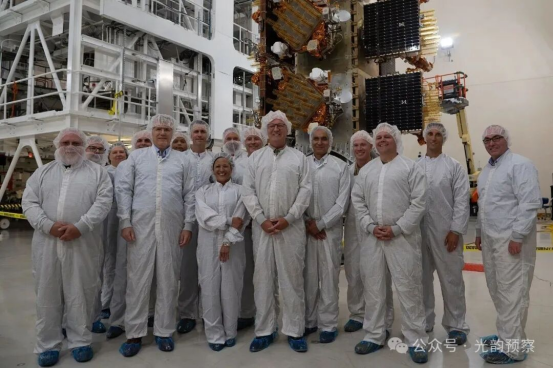
A Tranche 1 Transport Layer satellite undergoing pre-launch checks. Image credit: U.S. Space Force, photo by SrA Daekwon Street
What it didn't say matters too: no on-orbit measured throughput, no link establishment success rate, no link availability figures were disclosed. A British electronics engineering outlet noted in its coverage that the installed count does not mean 84 terminals are simultaneously carrying traffic.
So 84 is a manufacturing metric. It proves one thing: a laser terminal design can now be produced, tested, launched, and put into orbit repeatedly—without having to be treated as a delicate precision instrument every single time.
That in itself is a threshold. The traditional approach to space hardware is low-volume customization with item-by-item qualification. But a constellation of several hundred satellites demands that suppliers maintain reliability at production runs of dozens or hundreds, without letting assembly deviations and component substitutions drag it down. Laser communications is shifting from an optics experiment to a repeatable electronics manufacturing problem.
Skyloom's product line is worth a look—it's fairly representative:
V'ger: SDA-compatible autonomous laser terminal, 1 to 10 Gbps class, supporting four link types: inter-satellite, satellite-to-ground, satellite-to-air, and satellite-to-sea
Scotty: LEO user terminal, handling connections to GEO relays, up to 20 Gbps satellite-to-ground
Uhura: Small GEO optical relay satellite, 1550 nm, 20 Gbps each for inter-satellite and satellite-to-ground, with RF backup downlink to ensure over 99% satellite-to-ground availability, capable of climbing from launch orbit to GEO in 5 days
Kirk: Low-cost optical ground station
The company was founded in 2017 and is headquartered in Broomfield, Colorado. According to industry database Orbit Codex, by August 2025 it had delivered 88 terminals for integration (a third-party compilation, not a company press release). In November 2025, IonQ signed an acquisition agreement, completing the deal on January 28, 2026.
A quantum computing company buying a laser communications manufacturer—the motivation is worth noting. IonQ's stated rationale is to treat free-space optical links as the fiber of a quantum network, connecting remote trapped-ion quantum processors. It claims this can cut satellite-to-ground quantum communication latency from hours to under one hour and boost throughput by up to 500%. During the same period, it also acquired ID Quantique, Vector Atomic, and Capella Space. The deal value has no publicly verifiable figure—don't confuse it with IonQ's $1.8 billion acquisition of chip foundry SkyWater.
II. Where the SDA Got Stuck
Sandhoo kept his comments brief in March. Asked why subsequent launches were paused, he only said, "We saw a handful of things, so we stopped to fix them before the next launch."
But in an interview with Satellite Today the same month, he said the line most worth quoting. To weave this mesh, a series of technical challenges had to be solved first—"The hard part is the optical cross links. So that's the next step."
He also blamed the biggest obstacles of the past two years on two things: the commercial supply chain ("To build products with consistent quality, this industry needs time to build up capacity") and multi-satellite testing ("It's easy with one, two, or three satellites. When you have a whole constellation, how to do testing and pass software testing takes time to learn"). On how fast is too fast, he said: "Speed cannot skip the verification you were supposed to do."
The list of what went wrong only came out just before launches resumed in July. By then he was much more specific: there were indeed software and hardware issues on the satellites in orbit, "some inspection items we still haven't finished"; thermal models were inaccurate, which ultimately forced the not-yet-launched batch to add extra thermal mitigation measures; and there was electric propulsion—the motors responsible for raising satellites from their insertion orbit to their operating orbit had problems. SpaceDaily's list added one more: delays in establishing contact with ground entry points.
From March to July, four months passed. That gap is telling in itself: at first, the SDA itself didn't fully understand what was broken.
Here's the timeline. In February 2022, the SDA split the work for 126 Tranche 1 Transport Layer satellites among three companies—York, Lockheed Martin, and Northrop Grumman—42 satellites each, for a total of $1.8 billion. The first batch of 42 (21 from York last September, 21 from Lockheed last October) went up a year later than planned, and problems were found after they were in orbit, so all subsequent Tranche 1 launches entered a "strategic pause." None of the 28 Tracking Layer satellites have launched.
The July 16 launch, designated T1TL-E, restarted a deployment that had been frozen for nine months. The cumulative number of Tranche 1 satellites in orbit is now 63, exactly half of the planned 126-satellite Transport Layer. These satellites will first undergo testing and checks, then use electric propulsion to climb to an altitude of about 1,000 kilometers. The SDA says Tranche 1 will provide "initial warfighting capability" starting in 2027—the term being initial warfighting capability, not IOC.
Tranche 1 as a whole consists of 126 Transport Layer plus 28 Tracking Layer satellites—154 operational satellites in total—plus four missile defense demonstration satellites. Sandhoo said there are seven more launches to come.
This is not new. The Government Accountability Office (GAO) issued a report on February 26, 2025, titled "Laser Communications: Space Development Agency Should Establish links Between Development Phases." It concluded that the SDA "has not yet fully demonstrated this technology in space" and recommended "fully demonstrating its capabilities before further investment." The implication: the SDA's two-year tranche, build-as-you-fly acquisition cadence needs to slow down.
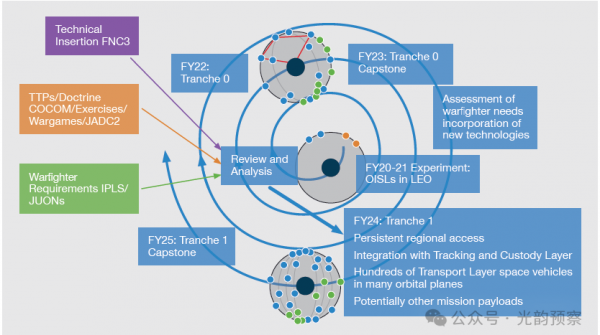
SDA's official illustration of spiral acquisition: each tranche is built as it flies, modified as it expands. Image credit: U.S. Space Development Agency
The report contained a set of figures that speak volumes. As of December 2024, in Tranche 0—the technology demonstration phase—one of the four prime contractors had completed 3 of 8 planned laser communication capabilities, one had completed 1, and the other two had completed none.
The SDA pushed back publicly the next day. A spokesperson acknowledged that "GAO's statement that we have not yet demonstrated full laser communication capability is accurate," but stressed that Tranche 0's baseline objectives had been met and that T0 had "demonstrated the feasibility of an optical mesh network."
Both sides have a point, and that is the real state of affairs: verification has been done, production verification has been done, but an operational-grade mesh does not exist.
The GAO listed four difficulties: suppressing jitter; pointing, acquisition, and tracking precision sufficient for the two ends of a link to actually communicate; mitigating atmospheric disturbance when transmitting from satellites to ground and airborne platforms; and ensuring that terminals from different manufacturers can communicate with one another—a challenge that grows more complex with every additional vendor involved.
That last point is both the Achilles' heel of the SDA model and its most radical aspect. Rather than letting a single supplier handle everything, the SDA defined an Optical Communication Terminal (OCT) interoperability standard, requiring all satellites joining the network to comply with it—so that a Northrop satellite can talk to a Lockheed satellite, and a York terminal can connect with a TESAT terminal.
The standard includes a hard requirement: link establishment must be completed within 100 seconds, with a challenge goal of under 10 seconds.
On September 4, 2024, then-SDA Director Derek Tournear announced at a Defense News conference the first successful in-orbit inter-satellite laser link. It used German TESAT terminals aboard two SpaceX-built Tranche 0 Tracking Layer satellites. His words: "Much better than 100 seconds, but not under 10." The link was maintained for several hours.
That was nearly two years ago. The same report included a line better suited as a footnote: at the time, terminals from CACI and Mynaric had passed compliance certification but had not yet been demonstrated in orbit.
Standard compliance and operational capability in orbit are two different things.
Even harder evidence comes from Germany. TESAT disclosed in October 2025 that 62 of its SCOT80 terminals (80mm aperture, up to 100 Gbps, compliant with SDA OCT standard version 3.1) were already in orbit, and that the first cross-prime SCOT80 interconnection among SDA Tranche 0 prime contractors had been completed.
If you had to pick a single number to prove that "terminals from different manufacturers have actually talked to each other," it should be this one—not 84.
III. Why Switch to Laser in the First Place
This section is for readers who don't follow the field.
The reasoning is actually quite simple: radio frequency is running out of capacity. A LEO satellite passes over a ground station for only a few minutes, and massive amounts of Earth observation data have to be squeezed into those few minutes for downlink. The spectrum is getting increasingly crowded, and the bandwidth ceiling of traditional microwave communications is what it is.
The case for laser comes down to this: large available bandwidth, small terminal size and low power consumption, extremely narrow beams that are hard to intercept and jam, and no need for frequency allocation or radio licenses. NASA's Deep Space Optical Communications (DSOC) project conducted a two-year demonstration on the Psyche probe. On its final overpass on September 2, 2025, at a distance of 2.34 astronomical units (about 350 million kilometers) from Earth, it received 12.4 Mbps under partly cloudy weather; under clear skies at 2.28 AU, it achieved 20.8 Mbps. Earlier, at a distance of 30 million kilometers, the rate was 267 Mbps. In June this year, the Jet Propulsion Laboratory published a review of the system's architecture and ground laser transmitter operating results in IEEE Photonics Journal. The project has not been fully shut down, and the technical lead said there is an opportunity to restart it in the second half of this year.
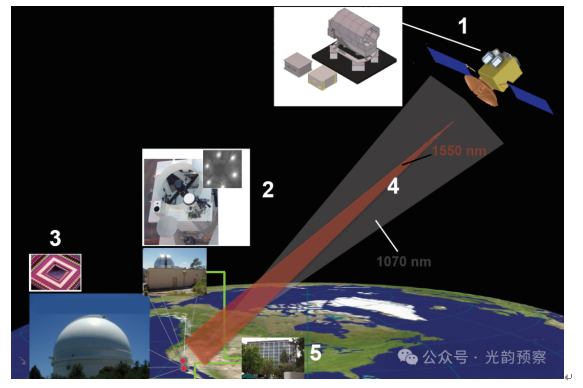
DSOC link geometry: how ground stations, beacon lasers, and deep space probes align on a beam. Image credit: NASA/JPL (public domain)

An infrared composite image of the Table Mountain optical communications laboratory in California transmitting a laser beacon toward Psyche. Image credit: NASA/JPL-Caltech, PIA26661
For a constellation, the real value of laser is not having to return to the ground every time. Inter-satellite links allow a satellite that cannot see a ground station to hand its data to a neighboring satellite, hopping link by link to a node with an exit. If a node drops out of the mesh, traffic automatically reroutes. This is what the SDA calls a mesh.
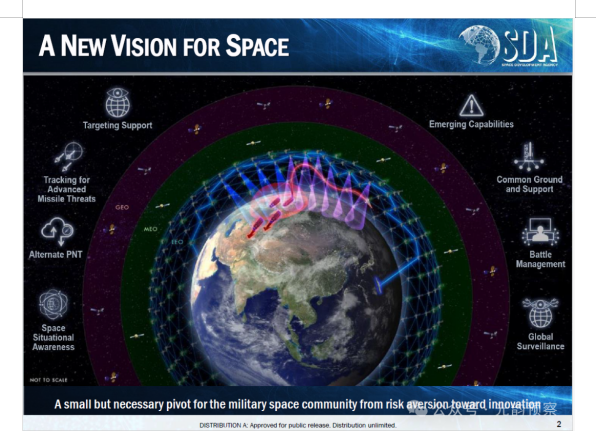
PWSA system architecture: how the Transport Layer, Tracking Layer, ground segment, and backbone network connect. Image credit: U.S. Space Development Agency
The cost is precision. Radio frequency can spread energy across a volume of space; laser cannot. Its beam is so narrow that pointing error alone can break a link—and both ends of the link are moving at several kilometers per second.
IV. Money and Deadlines Didn't Wait for It
This is the side I think most deserves to be written about.
On May 26, 2026, the Space Force awarded SpaceX the Space Data Network (SDN) Backbone contract: $2.29 billion, fixed-price, requiring delivery of a complete, operational prototype by the end of 2027. It is built on proliferated LEO, works in concert with the SDA's Transport Layer, and is positioned as the central hub of the "Golden Dome" missile defense architecture. A month earlier, in April, the Space Force had awarded up to $3.2 billion across 20 OTAs involving 12 companies, with a more specific target: space-based interceptor prototypes.
On July 13, 2026, the SDA awarded the Accelerated Missile Defense Tranche 3 (AMDT3): 36 satellites, $1.75 billion. L3Harris received up to about $955 million for 18 HBTSS-type missile defense satellites; Sierra Space received up to $798 million for 18 warning-and-tracking satellites, with two orbital planes each and launch readiness required in 2028. That is the same year Golden Dome is required to reach capability. The regular Tranche 3, awarded in December 2025 (up to $3.5 billion, 72 satellites), is not scheduled until 2029.
The supply chain is consolidating in parallel. On April 14 this year, Rocket Lab completed its acquisition of German laser terminal maker Mynaric for $155.3 million (a small amount of cash plus 2.277 million shares), following approval by Germany's Federal Ministry for Economic Affairs and Energy, with Mynaric retaining its Munich headquarters. The move slots laser communications into Rocket Lab's vertical system of "rocket plus satellite plus payload": Mynaric is to supply ConDOR Mk3 terminals for Rocket Lab's $1.3 billion, 36-satellite SDA contract, and has also been selected for the Tranche 2 Transport Layer Beta program.
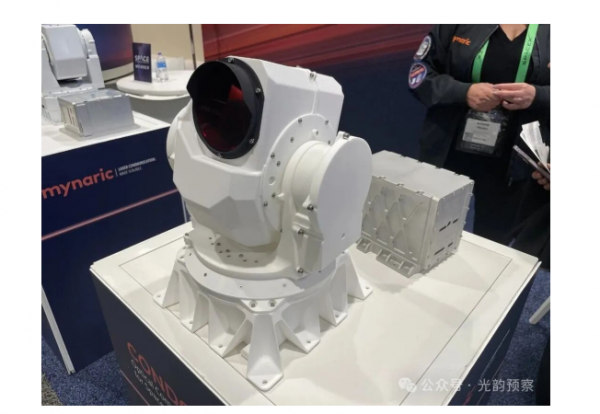
An actual spaceborne optical communications terminal: the Mynaric ConDOR Mk3.1. Photo by Blervis, CC BY 4.0
On August 13, Space Systems Command put another $60 million on the table, split among Amazon Leo, Lockheed Martin, Northrop Grumman, Rocket Lab, and York Space Systems (up to $12 million each in OTAs). The task was stated plainly: connect their own systems to the SpaceX-built backbone, and test a so-called "space exchange point" payload along the way. The latter was formerly called a "translation satellite," intended to interconnect the Tracking Layer, the MEO Resilient Missile Warning constellation, and even commercial constellations.
Hence the contrast: delivery deadlines have already been pushed to 2027 and 2028, while the Tranche 1 optical mesh meant to carry them was still not connected in the spring of 2026.
I don't know whether to see this as danger or as normal. In large-scale systems engineering, contracts and deadlines are always settled before the technology matures, and then engineering has to catch up. The SDA spokesperson also said the delays are not expected to significantly affect plans to provide early use in early 2027. You can read that as confidence, or as a commitment.
V. Lasers Begin Connecting Directly to Aircraft
An easily overlooked side branch.
In August 2025, the SDA and its partners completed a two-way high-bandwidth space-to-air laser demonstration, with a LEO satellite on one end and an airborne test platform in flight on the other. Details disclosed in September: an airborne optical terminal from General Atomics Electromagnetic Systems (GA-EMS), a 10-watt laser, mounted in a 12-inch laser airborne communications turret (LAC-12) built by the company's own aircraft systems division, carried aboard a de Havilland DHC-6 Twin Otter, established a 1 Gbps two-way link with a Kepler Communications LEO satellite compatible with the Tranche 0 architecture. Design peak was 2.5 Gbps and design range was up to 5,500 kilometers (some Chinese media cited a separate set of figures—30 cm aperture and a tracking rate of 25 degrees per second—but these cannot be found in primary English-language reporting and should not be treated as measured values).
It did not reach the design peak. But the entire sequence was completed: pointing, acquisition, tracking, locking, and uplink/downlink data exchange—and it verified interoperability between hardware from different manufacturers.
On January 28 this year, the SDA issued a request for information (SDA-SN-26-0008), soliciting airborne optical terminal proposals from industry. It explicitly stated which type of solution it prioritizes: one that can be rapidly demonstrated within 12 months and transitioned to operational service. Potential initial operational capability could come as early as 2027.
This line is worth noting separately, because Europe took a different path on the same problem. In December 2025, Airbus, TNO, and TESAT, under ESA's ScyLight program, used an airborne UltraAir terminal to conduct 31 closed-loop tracking and link-establishment sessions with the Alphasat TDP-1 geostationary satellite 36,000 kilometers away. Each session lasted 6 to 14 minutes, with seven of them maintaining stable transmission at 2.6 Gbps for several minutes with zero bit errors. The results were announced publicly in late February this year.
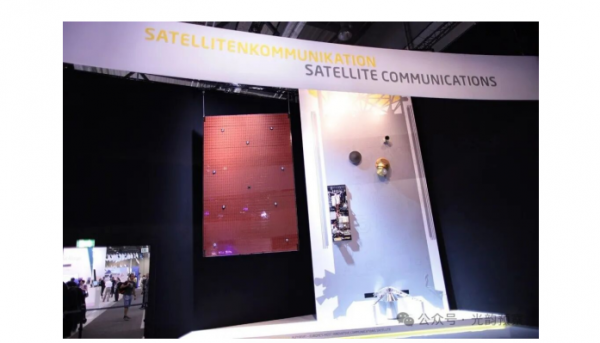
The satellite being connected: Alphasat. Photo by DLR, the German Aerospace Center, CC BY 2.0; its laser communication terminal is owned by DLR and operated under TESAT management.
The two sides' "firsts" should be viewed separately. U.S. reporting used "world-first" (an aircraft-to-satellite laser link), while Europe's framing was more restrained: ESA's release headline said "setting a new record," and optics.org described it as "the first public demonstration of this technology"—the phrase "world first" did not appear. The difference also lies in orbital altitude: the U.S. linked an aircraft to LEO, while Europe linked an aircraft to a geostationary satellite 36,000 kilometers away—the latter is harder.
VI. Meanwhile, on the Other Side of the Pacific
A quick comparison, without going into depth.
On January 30, 2026, the Aerospace Information Research Institute of the Chinese Academy of Sciences announced an operational application experiment in satellite-to-ground laser communications exceeding 100 Gbps: the 500mm-aperture system at the Tashkurgan laser ground station linked with the AIRSAT-02 satellite, achieving a communication rate of 120 Gbps, second-level acquisition and link establishment, a link success rate above 93%, a maximum continuous communication duration of 108 seconds, and a single downlink of 12.656 Tb.
The most interesting part is not the speed. Without changing any satellite hardware, the team used on-orbit software reconfiguration to boost the laser payload's capability from 60 Gbps to 120 Gbps.
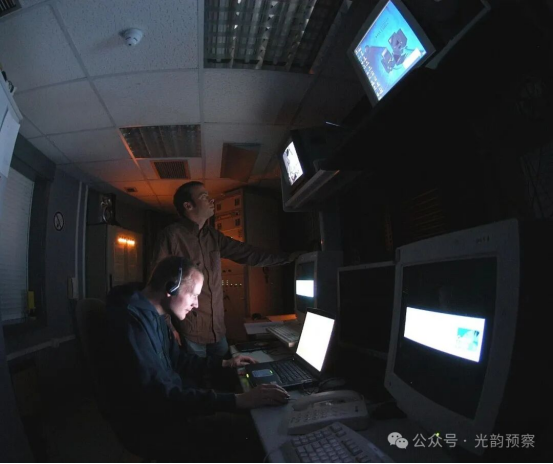
An illustration of an optical ground station (ESA's station in the Canary Islands, not the Tashkurgan station mentioned here). Image credit: European Space Agency, CC BY-SA 3.0 IGO
The industry side also accelerated that same year. A July research report by CICC estimated that, driven by satellite internet demand, the global market for laser communication terminals could reach RMB 50.2 billion. That is a forecast ceiling, not the actual scale for the year. Within just one month in July, five companies—Beacomm Technologies, Remo-Telight, Xingchen Optoelectronics, LaserPosts, and Laserlink—disclosed new funding rounds in succession, ranging from tens of millions to hundreds of millions of yuan each. Remo-Telight said it had completed in-orbit laser link establishment between satellites from different constellations, different orbits, and different manufacturers; Beacomm said its 400 Gbps inter-satellite payload would launch in September; Aurora Starlink said it already had 12 terminals operating stably in orbit and would deliver more than 100 units in 2026. All three are company claims without third-party verification.
The 15th Five-Year Plan outline lists inter-satellite optical communications as a core enabling technology for integrated space-air-ground information networks. Fast steering mirrors and high-speed photonic chips remain the most difficult links to localize, and the standards system for wavelengths, protocols, and interfaces has yet to be unified.
Most of these claims come from corporate press releases and research reports, so they should be discounted accordingly. But the direction is clear: both China and the United States are moving the same thing from the laboratory to the production line, just along different paths. The U.S. relies on military standards to mandate interoperability, while China relies on constellation demand to pull the market and a wave of new companies racing to build capacity.
VII. What to Watch Next
A few concrete things to watch. Come back this time next year to check the answers.
First, the SDA's remaining seven Tranche 1 launches. The Transport Layer still needs three (the batches built by Northrop and Lockheed); the Tracking Layer's four have not launched once. The count goes from 63 to 154 operational satellites, or 158 including four demonstration satellites.
Second, the optical mesh itself. The six-month window Sandhoo mentioned for starting to build it expires around September this year. What matters then is actual cross-vendor links, not terminal counts.
Third, whether anyone publishes measured data. So far, the number 84 is followed by nothing. link availability, link success rate, cross-vendor interoperability measured results—if any one of these gets disclosed, the industry's narrative shifts.
Fourth, the $2.29 billion SDN backbone prototype, due at the end of 2027.
Fifth, airborne terminals. The SDA wants a demonstration within 12 months, with IOC pointing to 2027. Europe has already demonstrated 2.6 Gbps. Whoever gets aircraft actually connected to this network first will decide the next round of orders.
Laser communications today sits roughly where data center networking was in 2005: components mature, direction clear, unit prices still high, standards still being argued over, and demand growing faster than anyone's budget spreadsheet.
 Order Frenzy: Laser Earnings Reveal 10B+ Backlogs — Who Wins?
 AI Compute Land Grab: What 30 Laser Earnings Reports Reveal
 Action-Cam Pioneer's Optical Pivot? GoPro to Sell Itself to Optics Firm for $285M
 Wuhan Team "Grows"Next-Gen Photovoltaic Film to Let Solar Panels Harvest More Sunlight
 Vietnam Plant + Europe Upgrade: Laser Leader Deepens Global Push
 Yang Gaojie, Rationalite Photonics: 3D Optical Computing to Break AI's Compute Wall
 Kingfit's Jin Songqing: Powering the Laser Industry Chain with Advanced Cooling Technology
 Laserion: Breaking Ultrafast Laser Bottlenecks to Industrialize Homegrown High-End Sources
 XTRI-tech's Yao Caihong: Building High-End Manufacturing
 Glitterin Tech's Three Photonic Pillars: Building the Optical Backbone of the AI Era