
Chip-Integrated Femtosecond Laser Enables Compact, Affordable Ultrafast Systems
source:Xinhua News Agency
keywords:
Time:2026-07-16
Source: Xinhua News Agency 8th Jun 2026
A research team at the École Polytechnique Fédérale de Lausanne (EPFL) in Switzerland has, for the first time, integrated a high-performance femtosecond laser onto a photonic chip. The device generates laser pulses with energies up to 1.05 nanojoules and pulse durations as short as 147 femtoseconds — performance comparable to that of traditional benchtop femtosecond lasers. The breakthrough opens a new path for the miniaturization and cost reduction of ultrafast lasers. The findings were published in the latest issue of Nature.
Photonic chips guide and process optical signals through tiny waveguides, functioning much like electronic circuits on a semiconductor chip. In recent years, many functions once only possible with large-scale optical equipment have been progressively integrated onto such chips. Femtosecond lasers, however, have remained one of the hardest challenges: they must simultaneously produce extremely short pulses while maintaining high energy, placing extraordinary demands on optical field control.
The key to this breakthrough lies in the team's adoption of a previously underexplored laser architecture: the Mamyshev oscillator. In this configuration, a nonlinear waveguide inside the laser cavity is positioned between two optical filters. As intense light pulses pass through the waveguide, they broaden into a wider spectral range, allowing them to pass through the filters and continue circulating. Weaker light cannot achieve this broadening and is automatically filtered out.
For scale comparison, the EPFL team's photonic chip is shown resting on a 1 Swiss franc coin, demonstrating how a laser architecture once confined to benchtop systems has shrunk to the millimeter scale.
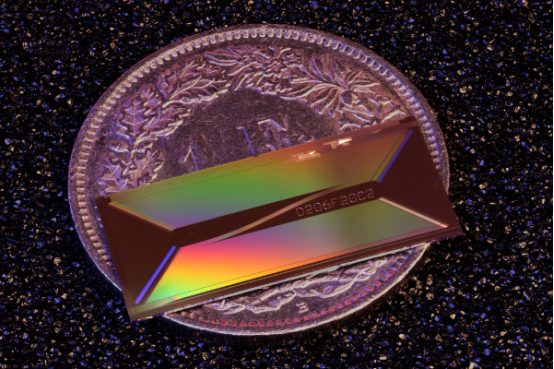
Image credit: École Polytechnique Fédérale de Lausanne
When light travels through the narrow waveguides on a chip, it experiences strong nonlinear interactions. In many conventional designs, this effect tends to destabilize laser pulses. The Mamyshev oscillator, however, is far less sensitive to this issue, making it better suited for chip-based implementation.
The team fabricated the chip laser using an erbium-doped silicon nitride platform. Although the total laser cavity length reaches 42 centimeters, a folded layout on the chip compresses it into an area roughly the size of a match head. The demonstrated sample fits easily on a 1 Swiss franc coin and is vastly smaller than conventional fiber laser systems.
Photonic chips can be mass-produced using wafer-scale processes similar to those used for semiconductor chips, with a single production run potentially integrating over 1,000 laser cavities. This means future ultrafast lasers could see significantly lower manufacturing costs, accelerating their transition from laboratories to broader real-world applications.
According to the team, this chip-scale laser could be used not only for spectroscopy, material defect detection and medical diagnostics, but could also become a key building block for future compact optical atomic clocks, underpinning next-generation communications and navigation technologies.
By Zhang Jiaxin, reporter
Editor's Note
The core value of this breakthrough is that it circumvents the longstanding bottleneck of chip nonlinear effects. The successful demonstration of the Mamyshev oscillator proves that photonic integration does not always require chasing new materials — established architectures can find new life on new platforms.
That said, important challenges remain unsolved: manufacturing uniformity across mass production, long-term stability, and packaging compatibility with existing optoelectronic systems. Researchers should accelerate the establishment of standardized testing frameworks and process specifications to avoid the familiar trap of "impressive in the lab, unworkable on the production line" — and truly move this technology toward real-world deployment.
 Order Frenzy: Laser Earnings Reveal 10B+ Backlogs — Who Wins?
 AI Compute Land Grab: What 30 Laser Earnings Reports Reveal
 Action-Cam Pioneer's Optical Pivot? GoPro to Sell Itself to Optics Firm for $285M
 Wuhan Team "Grows"Next-Gen Photovoltaic Film to Let Solar Panels Harvest More Sunlight
 Vietnam Plant + Europe Upgrade: Laser Leader Deepens Global Push
 Yang Gaojie, Rationalite Photonics: 3D Optical Computing to Break AI's Compute Wall
 Kingfit's Jin Songqing: Powering the Laser Industry Chain with Advanced Cooling Technology
 Laserion: Breaking Ultrafast Laser Bottlenecks to Industrialize Homegrown High-End Sources
 XTRI-tech's Yao Caihong: Building High-End Manufacturing
 Glitterin Tech's Three Photonic Pillars: Building the Optical Backbone of the AI Era