
Father of Shenguang Facility: Building Three Generations of National Strategic Equipment
source:Popular Science Suzhou
keywords:
Time:2026-01-22
Source:Popular Science Suzhou 14th Oct 2025
Fan Dianyuan (b. February 18, 1939), a native of Changshu, Jiangsu Province, is an academician of the Chinese Academy of Engineering and an expert in laser and optoelectronics.
For decades, he has been dedicated to the research and development of the high-power laser facility codenamed Shenguang, making outstanding contributions to the application of laser technology in China’s economic and national defense development, and is hailed as the Father of the Shenguang Facility.
01
Born in Kunming, Yunnan Province, Fan Dianyuan’s parents had fled to the rear area to escape the Japanese invasion when he was born. He spent his childhood living a displaced life with his parents in Chongqing, Guilin, Guizhou and other places, and returned to his hometown after the victory of the War of Resistance against Japanese Aggression.
In 1951, Fan was admitted to Changshu County Junior High School with excellent grades. One time, his family’s small alarm clock stopped working. He secretly took it apart and studied it for several days, then went to a bookstore to find books on clocks and watches. He not only figured out the clock’s working principle, but also found that the axle of the balance wheel had slipped slightly out of its bearing and jammed crookedly against the side. After he realigned the axle, the tick-tock of the clock filled him with the joy of success.
Fan’s father, Fan Baojiang, graduated from the Department of Dyeing and Weaving at the Advanced Engineering School of Zhejiang University. In 1953, he took up a teaching position in the Department of Mechanical Engineering at East China Institute of Textile Technology, and often brought Fan popular science books. Fan developed a particular fondness for Atomic Energy Power Stations among them.
During his senior high school studies at Changshu County High School, his physics teacher’s profound knowledge and vivid lectures fostered his keen interest in physics. He admired the spirit of Marie and Pierre Curie, who diligently researched atomic physics for the benefit of humanity. As the monitor of his class, he proposed naming their class the Curie Class.
In 1956, Fan was admitted to the major of Radio Physics in the Department of Physics at Peking University with a perfect score in physics. It was only after his enrollment that he learned the Nuclear Physics major was housed in another classified department.
During his university studies, he was fortunate to attend lectures by many renowned scholars, including Thermodynamics and Statistical Physics taught by Wang Zhuxi, Solid State Physics by Huang Kun, and Quantum Mechanics by Zeng Jinyan.
He spent all his university vacations reading in the Peking University Library, returning home only four times in six years. After graduating in 1962, he was admitted as a postgraduate student majoring in Microwave Engineering at the Institute of Electronics, Chinese Academy of Sciences (CAS).
02
Shortly after the invention of the laser, Wang Ganchang proposed initiating nuclear fusion with lasers. If nuclear fusion energy could be harnessed for power generation, it would benefit humanity for generations to come.
All developed countries invested in research for this purpose, and China also established the Shanghai Institute of Optics and Fine Mechanics (SIOM) specifically for this research endeavor. In 1964, Fan Dianyuan came to SIOM to engage in laser research under the guidance of his supervisor and stayed on at the institute after graduation.
Fusion energy is a form of atomic energy, and its development is far more challenging than nuclear fission used in nuclear power plants—a feat that demands the efforts of several generations. Fan Dianyuan joined the cause of laser-induced nuclear fusion and strived for and dedicated more than 40 years to this tangible atomic dream.
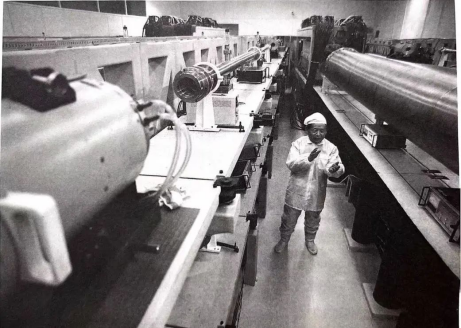
January 29, 1999, Fan Dianyuan at the Shanghai Institute of Optics and Fine Mechanics, Chinese Academy of Sciences
To make a smooth career shift to laser research, he first taught himself renowned works such as Principles of Optics and Introduction to Fourier Optics. He soon published academic papers including Optical Transfer Function Expressed by Ray Matrix Elements and Fresnel Number Expressed by Ray Matrix Elements.
He gradually became one of the core technical leaders and led his research team to successfully develop high-power neodymium glass laser systems with laser powers of 10 billion watts, 1 trillion watts and 10 trillion watts in succession.
He oversaw the formulation of technical plans, the overall system design, the development of unit devices and the full commissioning of entire systems, solving pivotal scientific and technological problems as well as practical engineering challenges. Meanwhile, he achieved a number of innovative outcomes in advancing basic theories and developing new technologies such as the overall design of laser systems, the theory and application of beam propagation, and the interaction between intense lasers and matter, making significant contributions to the pioneering and development of China's high-power solid-state laser technology.
These projects enabled China to secure a host of world-class research achievements in cutting-edge physical research fields including laser-induced fusion, the high-pressure equation of state and X-ray lasers.
03
In 1974, Fan Dianyuan conceived and designed a new type of laser amplifier that allowed laser beams to travel back and forth six times inside the amplifier, increasing the output laser power by an order of magnitude.
In 1980, the construction of the ShenguangⅠ facility commenced. Fan proved a new approach to the active control of planar tolerances both theoretically and experimentally, and introduced new technologies such as adaptive optics, enabling the generation of laser beams with both high power and high quality.
Two intense laser beams with an instantaneous output power of 20 trillion watts were focused on a target pellet, triggering the detonation of the pellet's outer wall. This exerted immense pressure on the deuterium and tritium inside the pellet, causing partial nuclear fusion under the extreme high temperature and pressure of the moment.
ShenguangⅠ stands as a milestone in the history of China's laser-induced fusion research, marking China's entry into the world's advanced ranks in this field. In 1990, this achievement won the First Prize of the National Science and Technology Progress Award. In 1995, Fan Dianyuan was elected as an academician of the Chinese Academy of Engineering (Department of Information and Electronic Engineering).
In the early 1990s, Fan Dianyuan also joined in proposing the ShenguangⅡ project, a tenfold expansion in scale, and served as its chief designer. In 1997, Deng Ximing, the project leader of ShenguangⅡ, was hospitalized with cancer, placing a heavier workload on Fan Dianyuan.
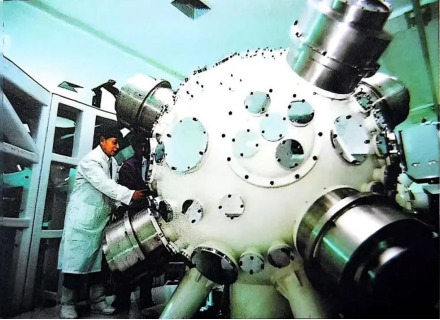
Fan Dianyuan (left) debugging the ShenguangⅡ laser facility, 1996
He could no longer return home regularly, and had to overcome the difficulty of having no one to take care of his young daughter who was in primary school, while enduring the profound grief of losing his wife Zhu Xiufeng—who had suffered from uremia for a long time and later passed away from a stroke.
He lived in the institutional dormitory in Jiading and worked overtime for a long stretch of time. In 2002, the ShenguangⅡ facility was finally successfully developed. Equipped with eight laser beams focused on a target pellet, the facility has carried out about dozens of rounds of physical experiments in research fields such as inertial confinement fusion and X-ray lasers, yielding excellent results.
04
In 2011, laser-induced fusion was included in the 16 major science and technology projects outlined in China’s National Medium and Long-Term Science and Technology Development Plan Outline.
As early as the initial stage of the 9th Five-Year Plan, Fan Dianyuan had devoted himself to the research and development of the giant ShenguangⅢ laser facility, serving as Leader of the Overall Technical Expert Group and Chief Engineer of the project. This facility would employ 48 laser beams with a total laser intensity 100 times higher than that of ShenguangⅠ, marking a major step forward toward fusion ignition.
Fan Dianyuan has supervised dozens of master’s and doctoral students to date, published more than 250 papers and reports, and presented China’s research achievements in the field of high-power lasers at important international academic conferences on multiple occasions.
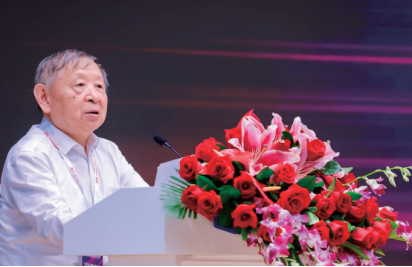
Fan Dianyuan delivering a speech at the 2024 World Laser Manufacturing Congress
He has been the recipient of numerous scientific and technological awards, including the Tan Kah Kee Award, the Special Prize of the Chinese Academy of Sciences Science and Technology Progress Award, the First and Second Prizes of the National Science and Technology Progress Award, and the Guanghua Engineering Science and Technology Award. He has also been honored with titles such as Advanced Worker of the National 863 Program and National Excellent Scientific and Technological Worker.
Fan Dianyuan lives a simple life and is known for being approachable and modest. He always attributes his achievements to the leaders and colleagues, especially senior scientists such as Deng Ximing and Yu Wenyan, a collaborator who joined the Shenguang project before him. Having devoted himself fully to the Shenguang projects for a long time, he was unable to go abroad, yet he has never regretted this choice—his only regret is the profound remorse he feels for not having taken good care of his wife.
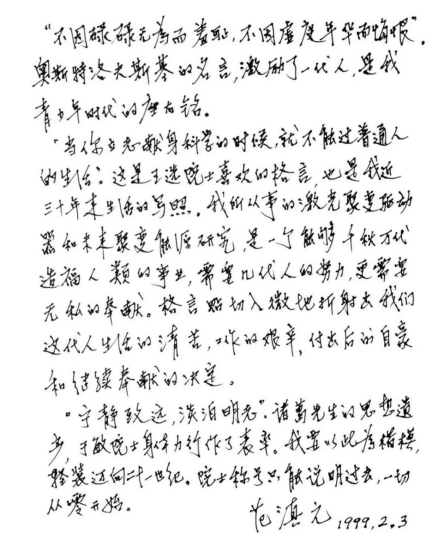
Handwriting of Fan Dianyuan
Fan Dianyuan has a profound affection for his hometown and is always glad to participate in events organized by Changshu. In 1999, he traveled to Changshu to attend the donation ceremony of Wang Ganchang’s archives.
In 2010, when the CPC Shanghai Municipal Committee produced a personal documentary about him, he visited Changshu again, went back to his alma mater, and donated his honorary certificates and other accolades to the Changshu Municipal Archives. In September 2012, the Suzhou Association for Science and Technology held the Suzhou Academicians Hometown Return Activity, and he came to Changshu once more to deliver a keynote speech titled Optoelectronic Technology in Innovative Development at the 2nd Changshu Academic Annual Conference.
 Order Frenzy: Laser Earnings Reveal 10B+ Backlogs — Who Wins?
 AI Compute Land Grab: What 30 Laser Earnings Reports Reveal
 Action-Cam Pioneer's Optical Pivot? GoPro to Sell Itself to Optics Firm for $285M
 Wuhan Team "Grows"Next-Gen Photovoltaic Film to Let Solar Panels Harvest More Sunlight
 Vietnam Plant + Europe Upgrade: Laser Leader Deepens Global Push
 Yang Gaojie, Rationalite Photonics: 3D Optical Computing to Break AI's Compute Wall
 Kingfit's Jin Songqing: Powering the Laser Industry Chain with Advanced Cooling Technology
 Laserion: Breaking Ultrafast Laser Bottlenecks to Industrialize Homegrown High-End Sources
 XTRI-tech's Yao Caihong: Building High-End Manufacturing
 Glitterin Tech's Three Photonic Pillars: Building the Optical Backbone of the AI Era