
Ultraintense 100 petawatt laser aims to uncover the secret of vacuum
source:Laser Focus World
release:Nick
keywords: petawatt (PW)-scale laser;Lasers
Time:2017-10-13
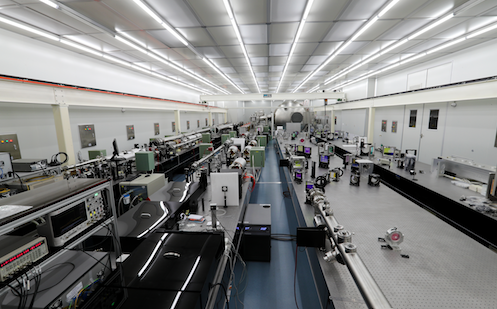
The 5 PW laser facility at Shanghai. (Photo: Shanghai Institute of Optics and Fine Mechanics)
In August 2016, a petawatt (PW)-scale laser at the Shanghai Institute of Optics and Fine Mechanics under the Chinese Academy of Sciences broke the world record for the highest-peak-power laser pulse by producing a 5.3 PW peak-power pulse with a pulse duration of less than 30 femtoseconds (fs).1 This year, the Chinese team, led by Ruxin Li, is beginning the development of a laser that will have a much higher peak power of 100 PW.
The new laser is part of the Hard X-ray Free Electron Laser (XFEL) Facility, as reported in a topical workshop on high repetition rate XFEL physics and technology held at Shanghai in August of this year (2017). The XFEL will deliver intense light at photon energies up to 15 keV.
The combination of the 100 PW laser and the XFEL will initiate exploration of the vacuum birefringence, one of the most prominent strong-field quantum-electrodynamic effects, says Ruxin Li, the project leader. Normally a vacuum is thought of as completely empty -- but according to quantum electrodynamics, it is actually full of virtual particles that continually appear and vanish.
The 100 PW laser will also help in research on acceleration mechanisms that lead to ultrahigh-energy cosmic rays, simulation of black-hole physics, and the generation of new forms of matter. These scientific pursuits are of fundamental physical importance and can potentially enhance our knowledge of the nature of the vacuum and the origin of the universe.
Since Lawrance Livermore National Laboratory in the United States opened the first PW laser facility in 1998,2 a number of labs around the world have succeeded in producing PW laser beams intended for research ranging from laser fusion to astrophysics. With the new 100 PW laser project, China is now taking the lead in this race. France, Germany, Japan, Korea, Russia, Spain ,and the United Kingdom have their own PW laser facilities. Meanwhile, the European Union is developing 10 PW laser facilities in Czech Republic and Romania under the Extreme Light Infrastructure program.3
The 100 PW laser system to be built in Shanghai will be based on the optical parametric chirped-pulse amplification (OPCPA) approach, with the aim of producing 1500 J pulse energies in 15-fs-long pulses, reaching a design intensity of higher than 1023 W/cm2. According to Ruxin Li, the 100 PW laser will be available for research in 2024.
REFERENCES:
1. Z. Gan et al., Optics Express 25, 5169(2017)
2. M. D. Perry et al., Optics Letters 24, 3(1999).
3. Edwin Cartlidge, Science 355,785 (2017).
 Vietnam Plant + Europe Upgrade: Laser Leader Deepens Global Push
 Three global heavyweights step up their China bets: What's behind the move?
 Big Four laser earnings: Winners, losers, and the ones fighting back
 Photonic chips land ¥1.1B in orders, funds, and financing
 Five Laser Firms See Executive Reshuffles: Younger Leaders Take the Helm
 Laserion: Breaking Ultrafast Laser Bottlenecks to Industrialize Homegrown High-End Sources
 XTRI-tech's Yao Caihong: Building High-End Manufacturing
 Glitterin Tech's Three Photonic Pillars: Building the Optical Backbone of the AI Era
 A Female Pioneer's 20-Year Quest for World-Leading Laser Thin Film Breakthroughs
 HSG Laser's He Hongming: Innovation Drives Laser Manufacturing Future