
SIOM makes world-first breakthrough in intense vortex laser direct electron acceleration
source:SIOM
keywords:
Time:2026-08-25
Source: SIOM 30th Jul 2026
The research team from the National Key Laboratory of Ultra-Intense Laser Science and Technology at the Shanghai Institute of Optics and Fine Mechanics (SIOM), Chinese Academy of Sciences, has demonstrated for the first time internationally the feasibility of direct laser acceleration (DLA) using relativistic Laguerre-Gaussian (LG) lasers, successfully generating stable, low-emittance, highly collimated ultrafast electron beams. This breakthrough overcomes the core bottleneck of conventional Gaussian laser-based DLA technology and opens a new path for the iterative development of frontier applications such as miniature particle accelerators and high-energy radiation sources.
The findings were published in Physical Review Letters under the title “Experimental Demonstration of Directional and Collimated Electron Acceleration with Hollow Laguerre–Gaussian Lasers,” Vol. 137, 025001 (2026).
With the rapid advancement of ultra-intense femtosecond laser technology, laser intensities have entered the relativistic regime (>10¹⁸ W/cm²). Under such extreme physical conditions, matter is fully ionized, forming a plasma of electrons and ions. Among them, the extremely light electrons can be directly accelerated by the laser electric field, a process known as direct laser acceleration (DLA). DLA serves as a core foundation for many frontier fields, including advanced accelerators, high-energy radiation sources, laser fast ignition, and attosecond science. Its technological breakthroughs directly affect the development of multiple disciplines.
However, conventional DLA technology has long been plagued by a core problem: it primarily relies on the longitudinal ponderomotive force of Gaussian lasers, but the transverse ponderomotive force of Gaussian lasers exhibits a Gaussian distribution that inevitably repels electrons sideways, severely hindering stable electron acceleration and greatly limiting the path of DLA from laboratory to practical application. This has become a bottleneck issue in the field.
Building on their earlier work in the generation and driving acceleration of intense LG lasers, the research team innovatively extended structured laser fields to electron acceleration experiments. The Laguerre-Gaussian (LG) laser, with its unique hollow intensity distribution and intrinsic orbital angular momentum (OAM), offers unprecedented possibilities for precise electron manipulation and is key to breaking the technical bottleneck.
Experimental results show that a left-handed circularly polarized LG laser possesses a distinctive longitudinal electric field on the optical axis, which, combined with the transverse field focusing effect, forms a stable “vacuum bubble” acceleration structure—analogous to the plasma bubble structure in classical wakefield acceleration. This provides an excellent environment for stable, efficient electron acceleration.
This achievement not only fills the experimental verification gap of relativistic LG laser-driven DLA but also breaks through the performance bottleneck of traditional laser acceleration technology, significantly enhancing the stability and collimation of electron beams, and laying a solid foundation for the upgrading and iteration of laser acceleration technology. Moreover, the acceleration gradient in the LG laser field is proportional to the laser intensity and independent of the complex plasma environment in subsequent stages. This feature opens a new path for fabricating micrometer-scale micro-acceleration structures, potentially bringing “miniature accelerators” from concept to reality. In the future, with further optimization, this technology is expected to be widely applied in ultrafast physics, materials science, medical imaging, and other fields, driving leapfrog development across related disciplines.
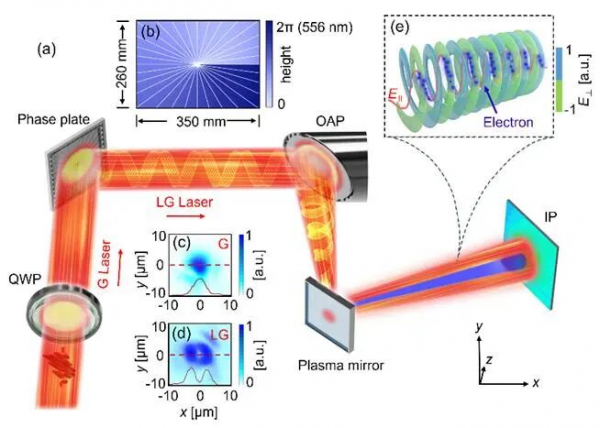
Figure 1. Experimental layout.
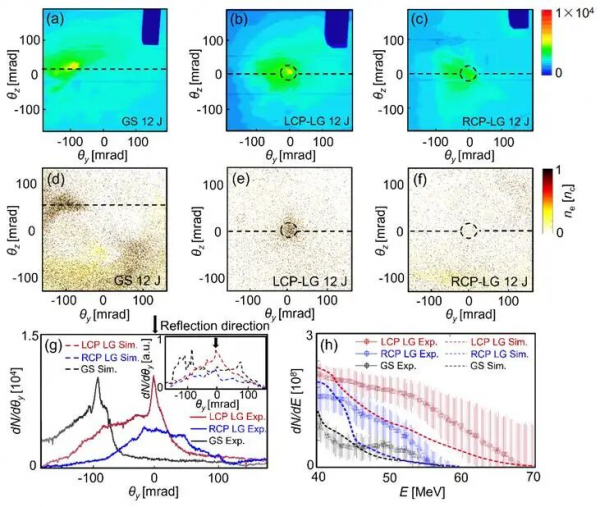
Figure 2. Experimental and 3D particle simulation results. (a) Experimental and (d) simulation results driven by a circularly polarized Gaussian laser; (b) experimental and (e) simulation results driven by a left-handed circularly polarized LG laser; (c) experimental and (f) simulation results driven by a right-handed circularly polarized LG laser. (g) One-dimensional electron angular distribution. (h) Electron energy spectrum distribution.
This work was supported by the Strategic Priority Research Program of the Chinese Academy of Sciences, the National Natural Science Foundation of China, and the International Partnership Program of the Chinese Academy of Sciences.
 Order Frenzy: Laser Earnings Reveal 10B+ Backlogs — Who Wins?
 AI Compute Land Grab: What 30 Laser Earnings Reports Reveal
 Action-Cam Pioneer's Optical Pivot? GoPro to Sell Itself to Optics Firm for $285M
 Wuhan Team "Grows"Next-Gen Photovoltaic Film to Let Solar Panels Harvest More Sunlight
 Vietnam Plant + Europe Upgrade: Laser Leader Deepens Global Push
 Yang Gaojie, Rationalite Photonics: 3D Optical Computing to Break AI's Compute Wall
 Kingfit's Jin Songqing: Powering the Laser Industry Chain with Advanced Cooling Technology
 Laserion: Breaking Ultrafast Laser Bottlenecks to Industrialize Homegrown High-End Sources
 XTRI-tech's Yao Caihong: Building High-End Manufacturing
 Glitterin Tech's Three Photonic Pillars: Building the Optical Backbone of the AI Era