
Robots Replace Farmers' Bending Work – AI & Laser Weed Out Precisely in Seconds
source:Wenhui Daily
keywords:
Time:2026-01-22
Source: Wenhui Daily 15th Jan 2026
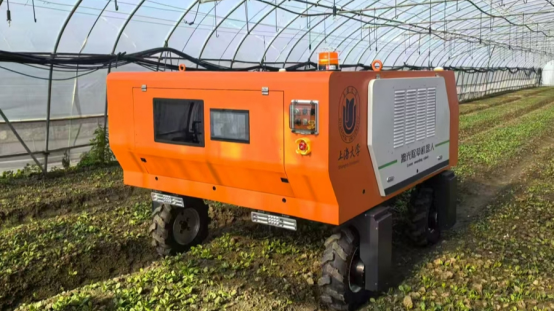
Robotic Farmers Are Here! In an organic vegetable greenhouse in Baoshan District of Shanghai, an intelligent weeding robot—1.7 meters wide and 1.4 meters tall—shuttles nimbly between the ridges. Without any manual control, it can automatically identify and lock onto weeds in milliseconds; a laser is emitted in an instant, and the weeds turn to ash on the spot. The entire process relies on purely physical operations with no pesticide residue, which not only addresses the drawbacks of low-efficiency manual weeding and rough traditional mechanical weeding, but also resolves the ecological problem of severe pollution caused by chemical weeding. This is the newly independently developed intelligent laser weeding robot by the research team led by Professor Miao Zhonghua from the School of Mechatronic Engineering and Automation at Shanghai University.
At present, the first prototype is undergoing trials and demonstration applications in over 100 mu of vegetable bases in Baoshan and Jiading Districts. "We want robots to relieve farmers of the toil of bending over and lighten the burden on the land," said Associate Professor He Chuangxin, a core member of the team, in an interview. He added that the team will introduce more intelligent technologies into farmland in the future to provide intelligent solutions for organic farming.
Intelligently Eliminating Weeds in an Instant, Solving the "No Suitable Machinery Available" Dilemma
In Shanghai, local organic vegetables rely heavily on greenhouse cultivation. Without the use of chemical herbicides, both manual and traditional mechanical weeding have their inherent shortcomings.
For example, in the high temperature and high humidity environment of a greenhouse, a farmer can only weed a maximum of one mu of land per day, as manual weeding is low-efficiency and highly labor-intensive. In contrast, mechanical weeding may seem more efficient, but it is prone to damaging crop seedlings and has limited applicability. He Chuangxin explained that although traditional mechanical weeders operate quickly, they lack precision. They are more suitable for widely spaced, neatly planted crops such as corn, but for common broadcast-sown vegetables like spinach and chrysanthemum greens, the seedlings look very similar to weeds. Weeders cannot tell them apart and thus adopt a blunt one-size-fits-all approach, often scraping up crop seedlings along with the weeds while weeding.
Another application limitation is that traditional weeders are generally designed for large-area, row-planted crops and cannot be used in greenhouses. This has led to the current dilemma of "no suitable machinery available" for greenhouse weeding.
To address these pain points, the team integrated large AI models, visual recognition, high-energy laser, unmanned driving and other cutting-edge technologies to realize integrated intelligent operation of "identification-positioning-elimination" in a purely physical way. The robot’s weed recognition rate has reached over 95%, and it can completely eliminate a weed in an average of one second, achieving the so-called "instant elimination".
Looking back on the entire R&D process, He Chuangxin told reporters that the primary challenge was to solve the problem of the weeder being unable to distinguish between crops and weeds. For this reason, the team built a self-developed million-level image dataset and established a large visual perception model for crops and weeds. Through AI algorithms, the model captures the subtle differences between weeds and crops, and its lightweight deployment compresses the entire "identification-positioning" process to within 20 milliseconds. "The laser strike must land precisely on the weed’s growing point. If it misses and hits a leaf instead, the weed cannot be completely eradicated," He said. As a result, the equipment can process 50 identification requests per second, enabling dynamic operation of "weeding while moving".
In addition, the robotic farmer is equipped with five sets of laser-vision modular operation units, capable of eliminating 5 to 10 weeds per second. He Chuangxin introduced that the team also adopted multi-sensor positioning to control the error of the laser emission point to the millimeter level. Even if crop seedlings grow askew, the robot can avoid them accurately, resulting in a crop loss rate of less than 1%.
Domestically Developed Equipment, Expected to Halve the Price
"Agricultural robots are not just ornamental pieces in the lab—they must be developed to meet the actual needs of the field," He said. The team has been deeply engaged in agricultural robot R&D for many years and boasts a multidisciplinary team of professionals in machinery, control, algorithms and other fields. Through hands-on practice in farmlands, the team has embedded pragmatism into every technical detail of the robot. Targeting the standard 1.2-meter width of greenhouse ridges, the robot is designed to be 1.7 meters wide, fitting perfectly to straddle the space between two furrows, and its wheelbase can be flexibly adjusted to adapt to the planting layouts of different greenhouses. Considering the insufficient light in greenhouses, the team added an active light supplement system and adaptive imaging control technology, allowing the robot to break free from light constraints and realize 24/7 all-weather operation.
Independent R&D has also brought significant cost advantages. "A foreign device of the same type costs more than 1 million US dollars, which is simply unaffordable for ordinary farmers," He Chuangxin disclosed. He added that the price of the domestically developed version is expected to drop by at least half in the future.
Technological iteration is still in progress. At present, the team is working to improve recognition accuracy, optimize laser layout and design a more compact version of the equipment. Meanwhile, they are perfecting the automatic correction system to ensure the robot can operate continuously without errors.
"The future of agriculture will definitely be the integration of intelligentization and green development," He Chuangxin said.
 Vietnam Plant + Europe Upgrade: Laser Leader Deepens Global Push
 Three global heavyweights step up their China bets: What's behind the move?
 Big Four laser earnings: Winners, losers, and the ones fighting back
 Photonic chips land ¥1.1B in orders, funds, and financing
 Five Laser Firms See Executive Reshuffles: Younger Leaders Take the Helm
 Laserion: Breaking Ultrafast Laser Bottlenecks to Industrialize Homegrown High-End Sources
 XTRI-tech's Yao Caihong: Building High-End Manufacturing
 Glitterin Tech's Three Photonic Pillars: Building the Optical Backbone of the AI Era
 A Female Pioneer's 20-Year Quest for World-Leading Laser Thin Film Breakthroughs
 HSG Laser's He Hongming: Innovation Drives Laser Manufacturing Future